

Breaking up isn’t failure; it’s a strategic reset. When a learning organization can no longer serve its children effectively, the boldest act of leadership is to redesign it. Be forewarned, if a school district is pushing “a redesign,” it doesn’t mean much; it’s a public relations driver, nothing more; it creates a curious pause in public opinion—nothing changes when the same people who compounded the opportunity try to fix their messes. We have yet to hear the words flourish, thrive, and advance in the nomenclature of MPS as it pertains to our future human capital.
Minneapolis Public Schools has a big opportunity (and if you have not viewed the video before reading this, it still makes sense). It’s facing a $50 million deficit in the 2026-2027 school year, which is three times larger than the deficit of any other district in the metro area. They have an estimated 30,000 scholars, many of whom do not get to school, yet the graduation rates rise. The school system uses only half of the 56 buildings they own, which together were built to house 43,000 scholars.
Already, the parents, caregivers, families, and scholars in the Minneapolis area are fleeing the system for other educational opportunities, such as charter schools, online options, the suburbs, or private schools. MPS is not receiving more state funding, and special education costs are skyrocketing. They spent the COVID-19 money they received and still act as though the problem can be solved with a single system. It can’t. People way smarter than me might say, there wasn’t anyone at the top of the district food chain thinking, Wow, this COVID funding is great, but what are we doing when it runs out? I forgot, succession planning is not a professional development option inside the district.
The answer? Break the system into three smaller districts.
Radical? Maybe. Let’s paint the picture…
The video below presents a strategic overview of the Tri-District Realignment for Minneapolis Public Schools:
Endless cuts, closures, and big-change plans are like a slow surrender. The problem began many years ago. Open enrollment and charter schools siphoned off nineteen thousand kids, more than a third of the city’s total student enrollment. The 2020 redesign? Disaster. School boundaries shifted, magnet schools shifted, and the public’s trust shifted. Families left. And now, with declining births and immigration, enrollment will likely continue to fall. Half the schools are underenrolled, wasting heat, wasting staff, wasting money. The central office is wasting the budget while the schools are hungry. Counselors are being reduced by twenty percent. Tutoring? Forget it. Excuses are given, not results.
Big school districts are failures. The one-size-fits-all approach ignores the Somali, Black American, Latin, and Hmong populations in the Northside, the achievement gaps in the Southside’s Black communities, and the changing populations and needs in the Uptown communities affected by gentrification. The split approach allows the zones to compete with each other. One zone could have twice as many immersion programs, another could have the most innovative literacy boot camps, and one could be clearly Tech/AI-focused, aka, STEM/STEAM. Parents will vote with their feet, and finally, there is some accountability, not the boardroom politics we have now.
The objection is that this would lead to segregation. But the charters are doing that now, behind closed doors. The smaller districts could compete against each other, using their strengths to overcome achievement gaps and achieve the highest reading scores, the safest schools, and the most parent input. But no, the big school districts are the only answer? Money talks the loudest. If the central office is too big, then trim it down. Pay less for busing after the redistricting. Robbinsdale is closing schools too, and we’re supposed to be happy with less?
The opportunity, in other words, is not the money itself but the system of decision-making that develops, an isomorphic approach that goes far beyond the simple realm of best practices. The opportunity, in other words, is not the money but the entire, overarching system of decisions, an isomorphic approach that embeds itself far beyond the simple realm of best practices. By the very nature of the approach, the entire system will replicate the essential logic of the environment in which it exists, creating an environment of conformity not only in action but in the very thought processes from which action emerges. The competitive advantage, in other words, lies not in the assets one has but in the highly refined, self-sustaining thought processes that determine the very nature of how, when, and why those assets are deployed. This isomorphic approach, in other words, becomes the “hidden” mechanism of success, perhaps more critical, perhaps more difficult to replicate, than the very money itself.
If Minneapolis Public Schools were split into three separate districts, it might be easier to understand how money (millions of dollars) travels through systems of accountability to include how state compensatory revenue focused on addressing the achievement gap is used. How do current MPS education funding formulas account for the operational realities of the school system?
For example, the billion-dollar buffet to fix the achievement gap:
Table: Minneapolis Public Schools Compensatory Revenue (FY2019–FY2026)
*Money to the District to Address the Achievement Gap
(Estimated district allocations based on MDE formulas and MPS budget reports; rounded.MPS is receiving well over $100M annually tied to the achievement gap.)
MPS Compensatory Revenue (FY2019–FY2026)
(Source-Cited Table Framework)
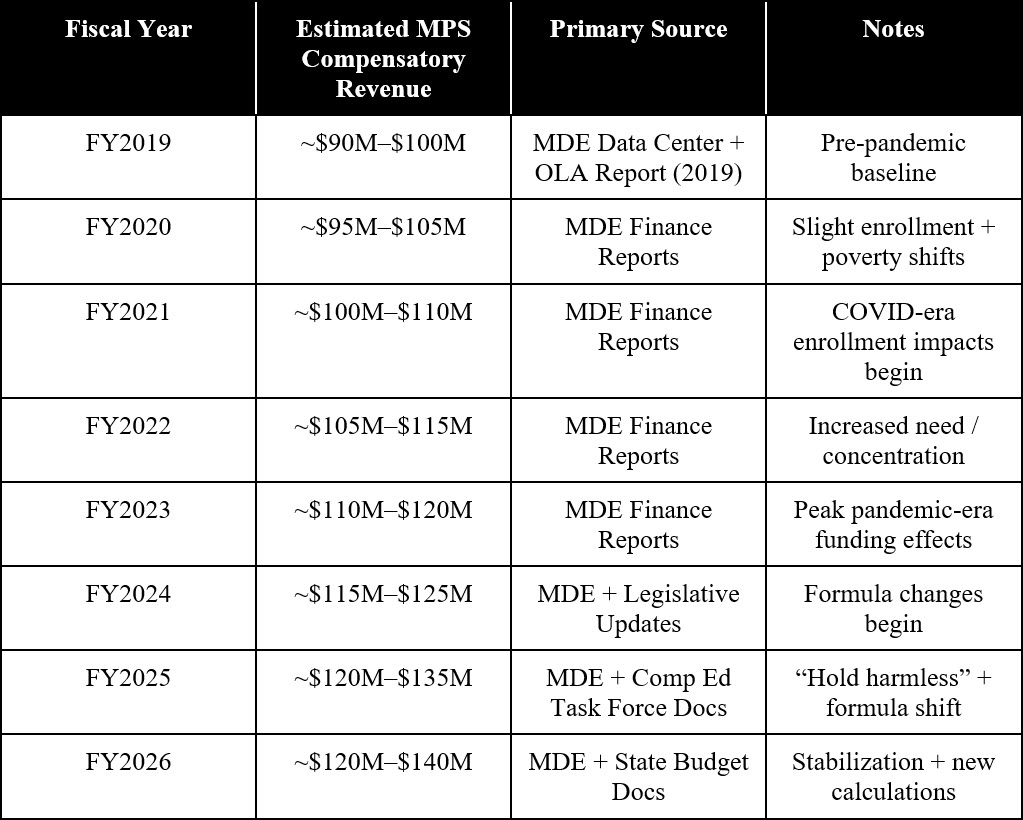
The issue is not a lack of funding (estimated $1 billion dollars, above), but instability and misalignment in how funding operates within the system. MPS consistently receives one of the largest compensatory allocations in Minnesota due to high concentrations of poverty. At this point, somebody must understand that fragmentation isn’t chaos; it’s efficiency. Former Minneapolis Public Schools Superintendent Peter Hutchinson said: “If the Minneapolis Schools want to compete, the money is in the buildings they should be closing” (Star Tribune, 2026).
Ultimately, the goal of this potential restructuring is not merely administrative; it is fundamentally about ensuring that every dollar intended to improve student outcomes, especially for those who need it most, is used efficiently, transparently, and effectively. The complexity of the current system hinders a clear understanding of best practices. Unless there is prodding of its financial metabolism, making systemic improvements will be difficult to diagnose and implement.
Why should Minneapolis split its schools into three separate districts?
The problem with the current school district is that it is using too many empty spaces and wasting the money that could be spent on school kids. Instead of flushing tax dollars down empty classrooms, the school system could invest in tutoring for students who need it and in support for teachers who wish to provide additional help to struggling readers, with a particular focus on ensuring that all children can read at grade level by the end of third grade. The READ Act in Minnesota defines children’s struggles as a function of how they are taught, and if you fix how they are taught, kids can start to do better; that isn’t the problem in Minneapolis, however, and it won’t get worse with more rules; it will get worse.
The community must push the MPS to reorganize the Minneapolis districts into three and channel our dollars more effectively. We need to build trust by efficiently administering schools and providing our children with something to trust. By closing empty classrooms and investing in tutoring and other academic support, we can begin to rebuild what we have lost.
Minneapolis Public Schools is getting left behind while some of our city’s charter schools thrive. Maybe it’s time to try an “experiment” of reorganizing the city into smaller school districts (north, central, southwest Minneapolis, etc.) or perhaps divide the district into three zones. Each zone sanctions two charter schools as community partners in education. If that doesn’t work, try something else, but doing nothing while continuing to falter is pure folly.
When a school district fails, it is not just the students who suffer. The school district is a significant entity in a neighborhood or area. When it falters, the entire district or section of a city can become unstable (see the Central neighborhood in Minneapolis after the closing of Mpls. Central in 1982). People do not want to live in an unstable area; thus, they leave. The failure of Minneapolis Public Schools is a Minneapolis problem.
Splitting isn’t a breakup; it’s surgery.
Give families options, not obituaries. Minneapolis deserves better than a bloated corpse who cannot define equity and pretends to teach.
Next: Deconstructing Minnesota’s Black Men Teach program: Progress or Drift?

Minneapolis does not have a school problem. It has a people problem. Broken families = broken schools. Broken schools = broken cities. How can you expect a society to function properly when at the heart of it all it does not protect the sanctity of human life? Abortion is not just killing a life, it is killing a city. Restore the family first. Everything else is reorganizing furniture on the Titanic.
Are there any physical boundaries to go along with these proposed districts? The lack of geographic discipline to this proposal makes attendance maps required by this split hard to imagine. Ella Baker in the heart of Uptown is grouped in the new North District. Kenwood which presently feeds North High, is in the SW District. Uncertainty is likely to drive more families out of the district.
I find this piece discouraging. I agree that the schools are not functioning well but the proposed “solution” which in the first place is not very clearly articulated, seems likely to make things worse. It will indeed, I think, just increase class division and inequity. And the proposed “surgery” will make it even more difficult than it is now to monitor the performance of school administration. We already have confusingly disparate park districts and wards in the city. With the change, concerned citizens will need to keep track of what school district they are in as well.
I suggest that there should be some effort to professionalize the city school board, perhaps by some kind of civil service type of examination like the ones which auditors have to pass to be allowed to take elected auditor positions. And the public schools should stop passing pupils from grade to grade whether they have mastered the basics of their grade level or not. Similarly there should be much less tolerance for truancy. I have mentioned ways to get classes of mixed ability students to function well before. At the same time programs which take account of the special problems of many children of BIPOC backgrounds should continue.
I do agree with the idea that underused buildings should be sold and student bodies consolidated to address the
financial problems.
The author of this piece should, I think, look up the definition of “isomorphic”.
Woods Halley
You’re on the right track, Don, but haven’t gone far enough. Dissolve the MPS and create seven new districts each with one high school. I’m not sure what to do with FAIR, maybe make it an eighth district that consists of one K12 building.
Central administrations are no longer useful. Boards of Education of these seven new districts might actually understand what’s happening in the entities they serve.