
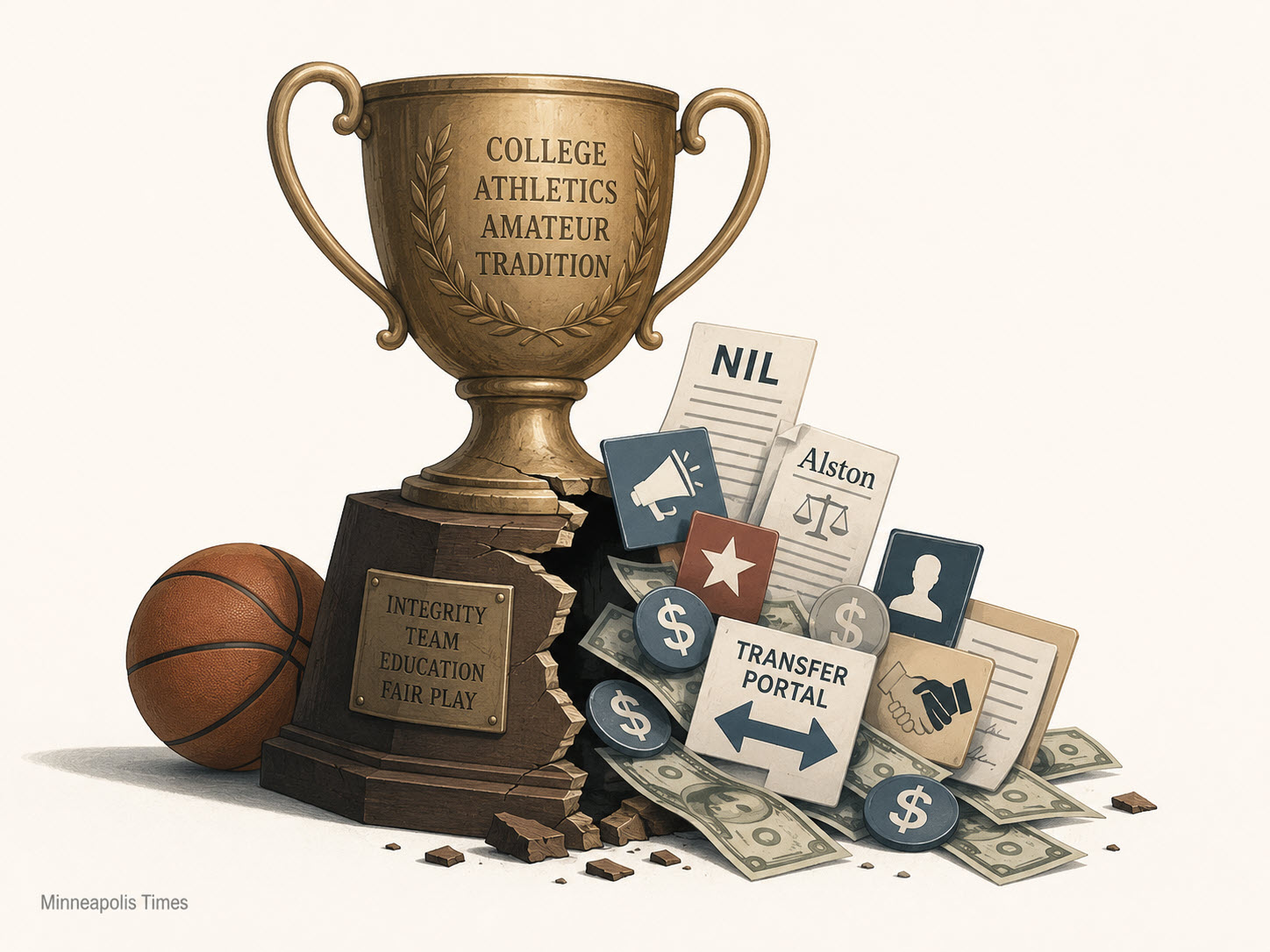
This week marks a historic milestone—Thursday, July 2, to be precise—signaling the fifth anniversary of the first Minnesota athlete to fully capitalize on the novel, revolutionary architecture of Name, Image, and Likeness (NIL) in what had heretofore been considered the pristine, strictly guarded domain of amateur athletics.
This structural transformation materialized when Minneapolis high school basketball phenom Hercy Miller—one of the two prodigy sons of hip-hop entrepreneur Master P (Percy Miller)—graduated from basketball powerhouse Minnehaha Academy in the southern quadrant of the city. Weeks later, Miller secured a staggering, multi-sponsor corporate endorsement package valued at $2 million. This lucrative contract served as the cornerstone of his high-profile commitment to enroll and compete at Tennessee State University, a prominent historically Black university (HBCU).
This unprecedented transaction occurred less than two weeks after the Supreme Court of the United States permanently altered the socioeconomic landscape of collegiate sports. By allowing amateur athletes to receive outside commercial compensation, the High Court dissolved protectionist restrictions historically enforced by the structural governance of collegiate athletics, the National Collegiate Athletic Association (NCAA). That amateurism barrier collapsed when a unanimous Court ruled in the landmark case National Collegiate Athletic Association v. Alston that the NCAA’s long-standing restrictions on education-related benefits constituted an unlawful restraint of trade in blatant violation of the federal antitrust frameworks established by the Sherman Anti-Trust Act.
The Modern Collegiate Conundrum: Portals, Settlements, and Sovereignty
The legality of player monetization, vastly compounded last year by the monumental $2.8 billion settlement in House v. NCAA, has funneled historic capital directly to collegiate—and increasingly high school—competitors, alongside their agents, attorneys, and immediate families. Yet, this unfettered liquidity, abetted by the revolutionary transfer portal system allowing unrestricted annual migratory mobility between academic institutions, has triggered an administrative crisis. This systemic disruption prompted President Donald Trump to accurately characterize the landscape as an operational “mess” during a White House sports conference this past spring, wherein he characteristically pledged to execute a comprehensive executive solution.
Some of these regulatory afflictions may find alleviation through a pending bipartisan legislative vehicle moving through the nation’s capital. Spearheaded by Republican Senator Ted Cruz of Texas and Democratic Senator Maria Cantwell of Washington, the Protect College Sports Act of 2026 (PCSA) seeks to impose federal caps on NIL payouts and narrow the operational parameters of the transfer portals.
As chronicled in this publication this spring, the legal origins of this contemporary NIL gold rush, along with Miller’s initial multi-million-dollar dive, are traceable to an influential federal judicial decision rendered here in Minneapolis in 1970. That precedent recognized that professional athletes must be civilly compensated for the unauthorized commercial exploitation of their names, biographical statistics, and identities under the nascent common-law rubric of the “Right of Publicity.” (See “College Sports Mess that Trump Pledges to ‘Solve’ is Rooted Here” in the April 9, 2026, edition of the Minneapolis Times).
While analyzing that historical lineage, our previous commentary did not fully interrogate the fundamental logical flaws within the Supreme Court’s Alston ruling—doctrinal missteps that directly precipitated the contemporary athletic crisis. As we mark the fifth anniversary of young Miller’s groundbreaking invocation of corporate sponsorship, it is highly opportune to review the structural foibles animating that decision.
Dissecting the Precedent: The Multi-Layered Flaws of Alston
The Alston decision and its subsequent legal extensions are underpinned by several fallacious predicates that systematically distort traditional labor and educational paradigms:
-
The Exploitation Fallacy: Writing for a unanimous Court, Justice Neil Gorsuch invoked a rhetoric of pathos, depicting college athletes as vulnerable assets exploited by wealthy academic institutions. He emphasized the racial demographics of high-profile football and basketball programs, characterizing the restriction on compensation as a form of economic peonage that demanded remedial intervention.
-
The Redistributive Paradox: The ruling presumes that because athletic conferences generate hundreds of millions—and even billions—in media rights, the student-athletes are entitled to a corporate-style revenue share. Gorsuch propounded that players deserve a “measure of compensation more equivalent with the value they bring to their schools.” This redistributive “spread-the-wealth” ethos reflects an economic theory that would ordinarily cause the Court’s conservative supermajority to shudder if applied to any other sector of corporate America.
-
The Executive Salary Equivalency: The Court fallaciously justified player compensation by pointing directly to the multi-million-dollar salaries commanded by athletic directors, administrators, and head coaches. This equivalence introduces a slippery slope, suggesting that lower-tier corporate workers possess a legal right to wage escalations based solely on the lavish compensation packages of executive-level management—an ideological attack on top-tier earners entirely antithetical to free-market conservative thought.
-
The Employment Relationship Threat: The true linchpin of this jurisprudential shift resides in the sharp-edged concurring opinion delivered by Justice Brett Kavanaugh. Kavanaugh directly equated student-athletes with corporate workers, asserting that nowhere else in the American market can joint ventures collude to deny individuals a fair market rate. By framing student-athletes as legal “workers,” this reasoning threatens to trigger a regulatory domino effect that colleges dread: rendering universities vulnerable to mandatory workers’ compensation, statutory minimum wage and overtime requirements, third-party tort liability, workplace discrimination claims, and compulsory labor unionization.
The Vicious Circle: Legalized Gambling and Capitalist Realities
The Alston precedent does not bear sole culpability for this collegiate malaise. Three years prior, in the landmark Tenth Amendment case of Murphy v. National Collegiate Athletic Association, the High Court invalidated a federal statute that prohibited states from authorizing sports gambling. This judicial preemption unleashed a massive, multi-billion-dollar sports-betting apparatus that has fundamentally transformed broadcast engagement. This gambling boom serves as an economic engine, driving unprecedented television ratings, commanding record-shattering corporate advertising rates, and generating the massive capital pools that universities now distribute to their newly minted athlete “workers.”
This economic amplification functions as a self-sustaining loop. Rather than repelling traditional fandom, the extreme financial chasm opening between amateur athletes and the ticket-buying public has only intensified media consumption. Simply put, highly compensated performers do not alienate the public; they cultivate an aura of high-stakes spectacle. Just as the astronomical payouts commanded by musical icons like Taylor Swift generate exponential consumer demand rather than diminishing it, the financialization of collegiate athletics has accelerated its entertainment value.
Epilogue: A Prussian Aphorism and a Vagabond Journey
The metaphorical ball now rests squarely in the court of the federal legislature as the Protect College Sports Act of 2026 awaits its fate. Yet, whether the solons of Congress can execute a clean regulatory slam dunk remains highly uncertain. What final statutory product will emerge from the nation’s capital remains an open question, invoking the timeless wisdom of 19th-century Prussian Chancellor Otto von Bismarck:
“Laws are like sausages; it’s best not to see them being made.”
Meanwhile, the initial $2 million endorsement package that secured Hercy Miller’s status as Minnesota’s NIL trailblazer has been thoroughly eclipsed by modern valuations, with top-tier football and basketball recruits routinely commanding deals approaching $10 million. Regrettably, the on-court collegiate career of the rapper’s son did not match its initial lucrative fanfare. After a stellar high school tenure at Minnehaha Academy—a legendary local program that has produced multiple state championships and elite NBA talent like Jalen Suggs of Orlando and Chet Holmgren of Oklahoma City (both via short, dominant tours at Gonzaga University)—Miller encountered a turbulent collegiate path. Plagued by persistent injuries that eroded his physical talent and limited his minutes, he embarked on a vagabond journey across four distinct universities, ultimately concluding his eligibility at the University of New Orleans, where his father sat on the basketball coaching staff.
While the older brother’s immediate professional outlook remains cloudy, the family’s athletic lineage continues to ascend. His younger brother, Mercy Miller, after a decorated high school career in Los Angeles, has joined the national powerhouse at the University of Houston, projecting an altogether brighter trajectory as a premium NBA prospect. Yet, wherever the unpredictable currents of professional basketball ultimately carry Hercy Miller, his place in local sports history is permanently secured: he remains the definitive pioneer who, five years ago this week, shattered the amateur paradigm and set the rapid pace for corporate monetization in the state of Minnesota.
