
“Leave indigenous land sacred and piss on the white corpses.”
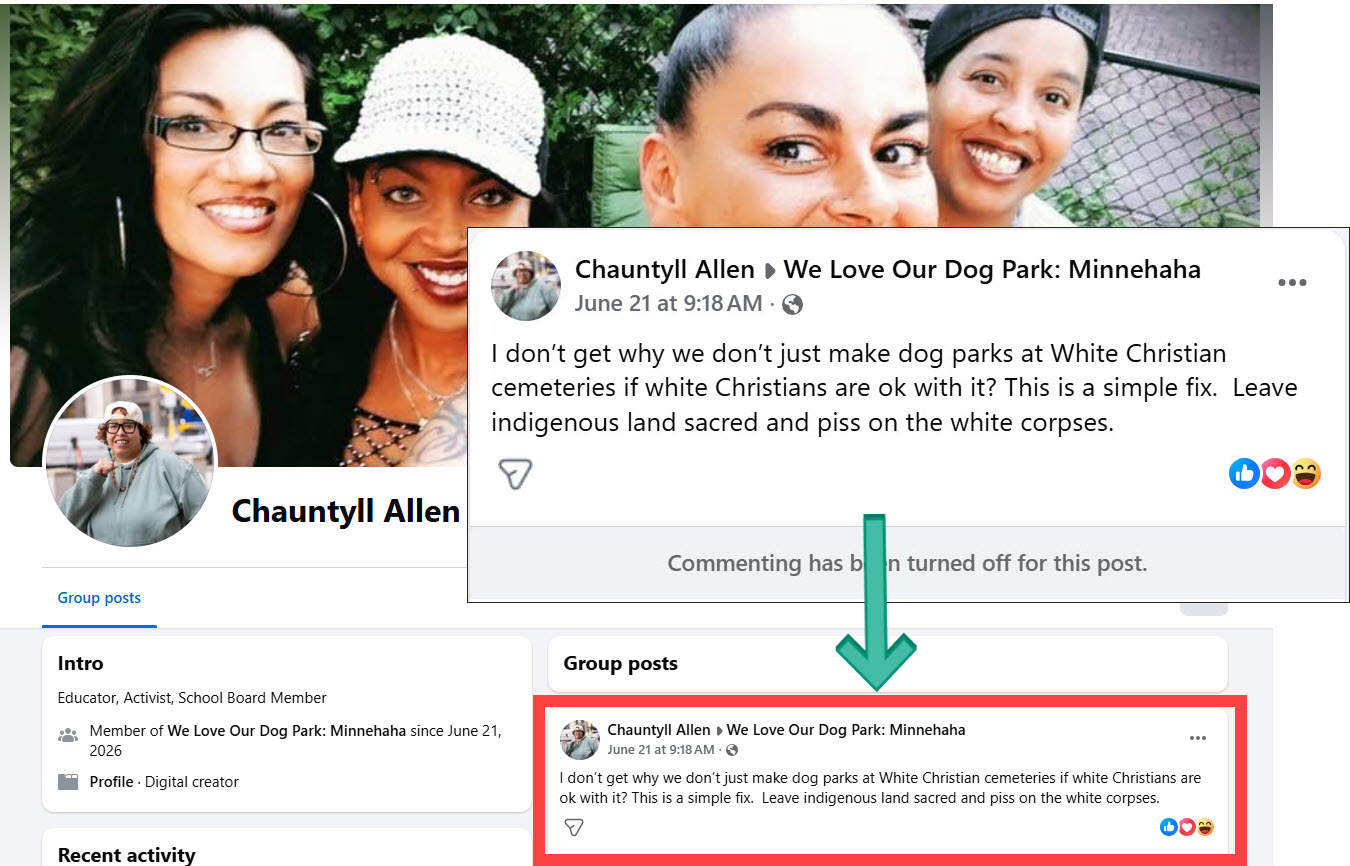
“Leave indigenous land sacred and piss on the white corpses.”
I have been thinking about this sentence off and on for days.
Not because it is the cruelest thing I have ever read, or because social media has suddenly become vulgar.
The sentence lingers in part because of who wrote it.
Chauntyll Allen serves on the Saint Paul Public Schools board. She founded an organization called Love First. She has become a visible activist voice in the Twin Cities and was present during the disruption of a service at Cities Church, where activists entered the sanctuary, confronted the pastor during worship, and turned a Sunday service into a scene of intimidation and fear for families gathered in prayer. Shortly after participating in the Cities Church incident, Allen was publicly honored during Women’s History Month as a Black Woman of Impact.
She is not an anonymous account with a cartoon avatar.
She is a civic leader. A person entrusted with the education of children. And for many, a recognizable face and respected voice in the community.
The statement appeared amid an ongoing debate over a Minneapolis dog park located on land that holds particular historical and spiritual significance for some Indigenous people. Questions about sacred places, historical memory, and competing uses of public land are worth taking seriously. And people of good faith will disagree about what should happen to the park.
But “piss on the white corpses” is not an argument about land use or even historical wounds.
It is something else entirely.
The comment unsettled me partly because it felt familiar.
Last year, my son survived a shooting at his Catholic school. In the days that followed, I heard comments about “rich white kids in private schools.” I watched people speculate about privilege and tuition while families buried children. I became increasingly aware of a quiet contempt toward Christianity itself, as though the setting somehow clouded our ability to respond with uncomplicated grief.
Months later, I watched the disruption at Cities Church unfold.
Part of my reaction was personal.
My son and dozens of others spent terrifying moments sheltered in a church basement while children were murdered and gravely injured in the sanctuary above them.
But part of my discomfort came from the reaction to the event itself.
Or rather, the lack of one.
Very few people seemed willing to say plainly that confronting a congregation during worship had crossed a line. The politics surrounding the event seemed to matter more than the people inside the building.
Last night, I was giving my son a bath after “crazy hair day” at his summer camp. The thick red dye in his hair began running down his face and neck as I poured water over his head.
And for a moment, I felt sick.
Of course, my son was perfectly safe in our bathroom.
But trauma has a way of collapsing time.
The post referred to “white corpses.” But for me, the sentence landed somewhere that had very little to do with race alone.
It landed in a basement where children hid from a killer.
It landed in church pews where frightened parents held their crying babies and wondered what was happening around them.
It landed alongside comments about private school children and the apparent reluctance to defend sacred spaces when the people inside them belong to the wrong categories.
I think that is part of the reason Allen’s post unsettled me so deeply. Not because it was new, but because it felt like another piece of an ongoing story.
The shooting.
The comments.
The failure to condemn what is so clearly wrong.
The growing sense that certain people and certain places no longer seem to merit ordinary instincts toward empathy.
I spent years working in social services, where conversations about privilege, oppression, and inequity were common. At their best, these frameworks can help us understand how historical trauma, discrimination, and injustice continue to shape communities in the present. But I have begun to wonder what happens when the victim-oppressor paradigm becomes so rigid that individual human beings begin to disappear.
Ultimately, the dead buried in cemeteries are simply that: dead people. Whatever their politics, their race, or their failures, they cannot answer for history.
Yet increasingly, they become proxies for historical grievances that have very little to do with the lives they actually lived.
White.
Christian.
Privileged.
Colonizer.
Oppressor.
Once assigned, these identities become totalizing.
And when the categories become sufficiently fixed, the individual standing in front of us can disappear entirely.
I find myself returning to this question:
Does a person’s perceived social power determine whether contempt toward them becomes morally acceptable?
The debate over the dog park will eventually end.
The city will decide what to do with the land.
But I suspect I will continue thinking about that sentence.
“Piss on the white corpses.”
Not because it’s especially shocking. But because it revealed something I have increasingly struggled to ignore:
That some people have begun to exist primarily as representatives of history rather than as human beings.
And once that happens, hatred can begin to masquerade as virtue.
Sometimes it wears the clothing of compassion, borrows the language of justice, and even calls itself love.

The good news is that if you’re a Christian and live your life according to the Bible and the teachings of Jesus, none of this stuff really matters anyway.
Once again, St. Paul school board goes silent over member’s provocations
https://enewspaper.twincities.com/infinity/article_popover_share.aspx?guid=d0031299-0f5c-4c9e-b435-a19f1506aff1&share=true
A recent piece in the Pioneer Press on this..
https://www.twincities.com/2026/07/07/st-paul-school-board-member-chauntyll-allen-backlash-minnehaha-dog-park-comment/?share=psmhpwccsenlcotlcwgd
The confusing thing for me is the peeing and pooping part.
Dogs will still be allowed in that area, on leash, under this change, so of course they will be peeing and pooping…as far as they can go on their leashes.
But maybe less dog owners would use this setting IF the dogs cannot be off leash. If that is the goal, “less dogs in the area,” then that should be clearly stated, “we want less dogs there.”
Pooping and peeing will continue, where ever dogs are, whether off or on leash.
* Historically, people were buried or even discarded all over the place, many of them no where near a ” burial site or ground” or an official cementary. That would be the case for all races. My little house could be sitting on a burial ground now for one or two people, but of course, all would have gone back to the earth by now, decades and centuries later, which is exactly as it should be.
**Also…so much talk continues about what these white folks are doing to others, when so MANY of us are of mixed or inter/ multi racial backgrounds now, and those changes will continue. Maybe we should consider THAT, before all these charges and prejudices are leveled against people, simply for having an opinion on this matter.
I have to say, I heard Allen’s comments differently at first than Proctor did here. I’m gonna circle back to that at the end of my reply, but Proctor makes a really strong case for how she heard it here.
Like Proctor I am a practicing Catholic. I attend mass atleast weekly and am a parishoner at the Basilica. Proctor is right to point out the degree of contempt some people have for religious practice in this city. She is also right to point out the wierd contempt they have for folks who send their kids to private schools. At the Basilica we help support Ascension Catholic School, most of whose students are on scholarships. I am the first in my family to not attend Catholic school. It should be said that these schools aren’t merely for the wealthy. And of course, even if they were every soul who attends them would still be valued.
She writes about the Cities Church protest that Allen participated in. This is perhaps where my deviation from Proctor begins. My honest initial reaction to that protest was to support it. There is something incredibly perverse about a religious leader heading an agency that was so deeply harming the human dignity of the stranger. Our faith’s teachings are beyond clear about this, and yet there is a certain kind of Christian that seems to think they are only required to love the people who look and pray like they do.
But then I saw the video. I saw a family with young children who had fear in their eyes. I knew then that protest action was wrong, and I knew it was wrong for the same reasons I just wrote about above. As a Catholic I am required to love and care for everyone. Even if they pray differently than I do. Even if they are doing real harm to my community.
Circling back. The reason I heard Allen’s comments differently than Proctor was because I watched a Park Board meeting where frustrated and emotional natives tried to explain to the board and the community the importance of this site to them. They explained that Fort Snelling was used as a concentration camp after the Dakota war. They explained why the dog park hampers their use of the site as a sacred and contemplative place. They were countered by some the most entitled people I have ever seen. The dog owners appropriated native activists slogans to make them about dogs. They made clear that, to them, dog recreation has the same moral weight as the Dakota dead.
It bothers me that in her take down of Allen, Proctor didn’t interrogate this more. There seems to me to be a narrowness to Proctor’s writings. She wrote two pieces during metro surge that touched on the federal action here. In neither of her pieces did she use a single word to reflect on the terror being inflicted on immigrant families. I’d ask Proctor in this case and others to try to expand her field of view and share her compassion more broadly. That is something I am challenging myself to do as well.
Proctor focuses exclusively on her framing of what she sees as unjustly inflicted white pain. She spends soooo much time ramping up and rehearsing, Three Minutes Hate fashion, why she thinks Allen is a diabolical untermensch, that she somehow forgets to talk about the subject of Allen’s posting: white people like Proctor who want to keep defiling a Native gravesite.
As for the wide-eyed, apparently scared white kids at Cities Church: how much of that is because they have been told over and over again that African American people are evil and scary? That is part of the Cities Church doctrine:
https://minnesotareformer.com/2026/04/21/cities-church-and-its-white-christian-nationalism-deserve-scrutiny/
This a logical outcome of the fixation on identity politics: Accidents of birth are far more important than the content of character. Dr. Martin Luther King would roll in his grave if he could hear this. I was starting my freshman year of college when King made his wonderful observation at the March on Washington. I attribute the popular current thinking to a degeneracy of thought among many activists. Serious critical thinking is hard and apparently not nearly as satisfying as glib, vacuous sloganeering.
One could only hope that she chokes on her next cheeseburger.
I wish I was shocked by this, but it has become coin of the realm for the American left.
The scriptures have a uniform code of conduct for all persons. Why? Because it is the world we aspire to.
The scriptures . . . yes those . . . have a uniform code of conduct for all persons. Why? Pray on it and think about. The answer will come.
Given how hard it is to get rid of elected officials, ( all across the country) once they get in, thankfully this person did NOT make it onto the St Paul City Council.
As we watch St Paul working so hard to improve in all areas, under its new mayor, having a member like this on their council would have been disastrous.
“Chauntyll Allen is an at-large member of the Saint Paul Board of Education in Minnesota. She assumed office on January 6, 2020. Her current term ends on January 1, 2029.
Allen ran in a special election to the St. Paul City Council to represent Ward 4 in Minnesota. She lost in the special general election on August 12, 2025.”
Your article is showing a kindness this person does not deserve. The pure hatred this woman spews toward white people is what it is, racism. And she will call it justified. She has no good intentions, no desire to make the world a better place. You cannot fight racism with racism. It’s like throwing water on a grease fire. The context of the conversation does not excuse what she said. This woman is toxic in every way.
You know what they say…the most racist people aren’t white.
This is a problem for St Paul, and particularly for anyone wanting to raise children in that city, because they have to know now, that this is WHO is on the governing board for the school district there.
The concern is, for any child in THAT school district, that she may have little interest in helping or protecting them, IF the hue/ the pigment is not at a level that would be of any interest TO HER.
In terms of her pending court case, she clearly is not thinking ahead much, and she should be, as a grown….woman, and realize that this does not help her. But maybe she doesn’t want help, because the focus is only on inflaming and injuring.
She is also suggesting that no one other the white folks are trying to find a way to keep that setting open to people out with their animals. She is straight up wrong about that, but I don’t think that matters to her.
So you’re OK with indigenous gravesites being defiled?
It’s very telling to see the glee with which so many conservative white supremacists have latched onto an offhand remark – a remark none of them would have known about if it wasn’t for this article’s author’s determination find something, anything, she could use against the people who want to stop the defiling of a mass graveyard. Now they can stop acknowledging that the dog park defenders want to be able to keep defiling Native gravesites. Or that the “Cities Church” is a glorified Klan Klavern:
https://minnesotareformer.com/2026/04/21/cities-church-and-its-white-christian-nationalism-deserve-scrutiny/