
If Minneapolis Times article counts are accurate, I’ve written for this still relatively new voice in political discourse 14 times.
Some of my articles have inspired reader comments, and most of them have been of a cheerleading nature: You tell ‘em, Dave! they say. That’s not surprising. Minneapolis Times has a point of view, and it mostly attracts readers who share that perspective.
Once in a while I get comments that disagree with my articles. I value these even more, because why do any of us put our views out there, if not to stimulate discussion and debate?

I wrote recently about DSA, which holds a majority on our city council, not governing very well, for the obvious reason that they don’t know how, but for the less obvious reason that they aren’t very interested in city governance. (I won’t repeat my arguments here, just look for my “training wheels” article.) This piece drew some responses from one Wade3690, a local DSA member, who clearly was not buying what I was selling.
We had several exchanges through the Times comment section, which seemed to me to be civil and well-informed on both sides. At the inevitable “we’ll have to agree to disagree” final exchange, Wade had this to say: “As a DSA member I will be actively looking to increase our presence and influence in the Twin cities. Our current system of governance and fealty to wealthy people and big businesses have given us an incredibly unequal society and <we must> reverse that decline for the sake of the next generations and our planet.”
Not many Democrats/DFLers of any stripe would disagree with Wade’s conclusion. I surely would not. But DSA’s explicitly stated solution, the abolition of capitalism, assumes that great disparities do and always have existed, and the only way to fix things is by adopting a socialist model.
In order to answer this (and I told Wade I’d take a shot at this) I looked high and low in my vast electronic filing system, for a chart, which I believe explains much about why our society has not worked very well, since 1980, give or take a year or two. The chart shows how economic growth has been shared from the end of World War II – when things really took off – and the present. The gains accruing to capital, and the gains accruing to labor, were remarkably equal, from 1946 until 1980. Then the line on the graph showing gains to capital continued merrily along at the same rate as it had for the previous 34 years. The line showing gains to labor suddenly went flat and stayed flat.
Dang! I can’t find the chart! However, I found another one, that tells essentially the same story:
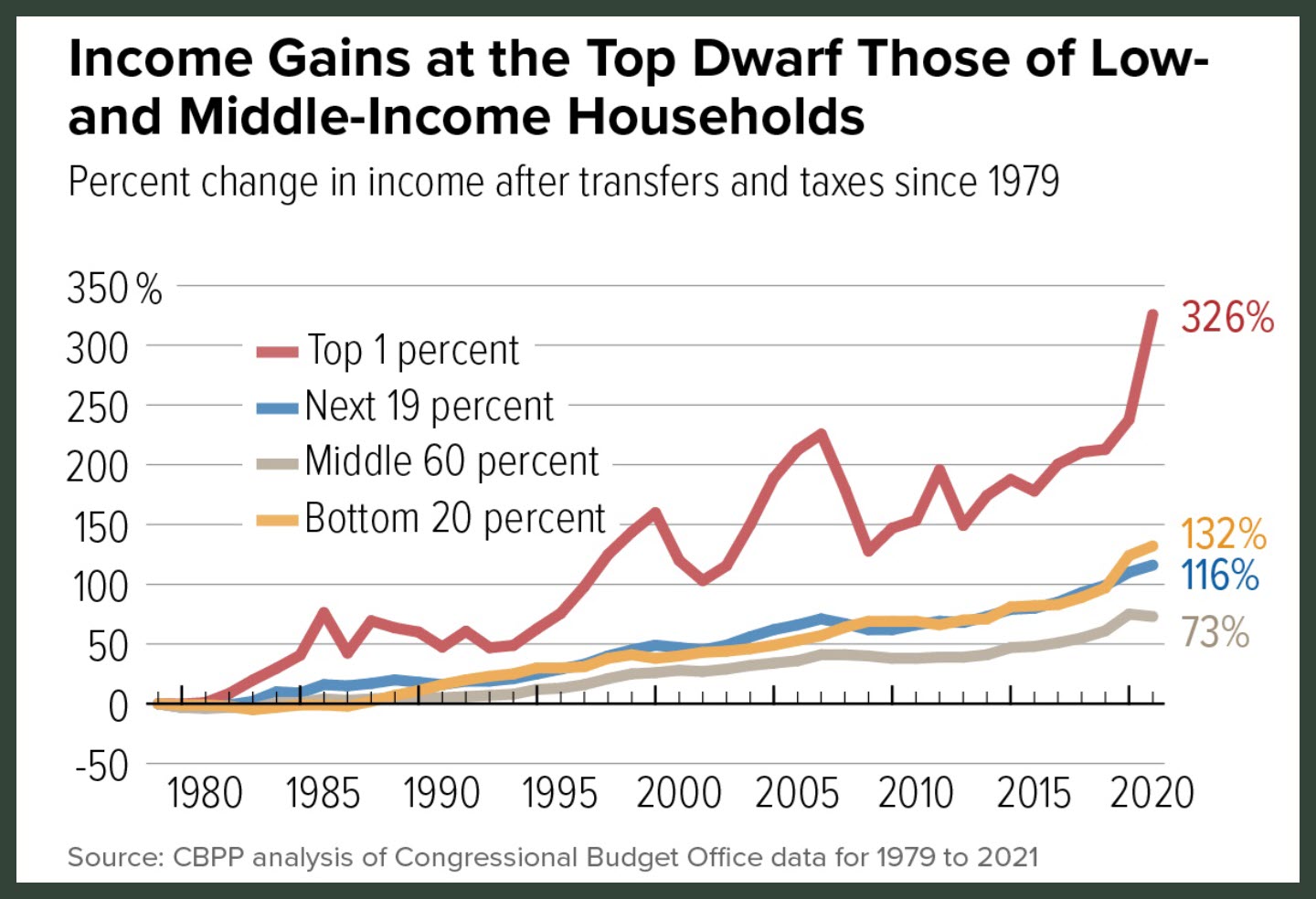
This chart, from Congressional Budget Office, shows that income to the top 1% has more than tripled since 1979, and stayed pretty flat for the rest of us. We’ve reached the point where the holders of 60% of our nation’s wealth could all find a seat on a Metro Transit bus. Not that they would ever deign to board one.
So what is magic about 1980 (or in CBO’s view, 1979)? Well, some big things happened starting then. We elected Ronald Reagan. We embraced trickle-down economics for the first of at least three times (we might have just begun the fourth) but it’s almost literally the case that so far not a single dollar has trickled. We deregulated one industry after another. Through judicial activism we embraced Citizens United, turning political campaigns over to the wealthiest among us, and letting them write the tax code and define the corporate and environmental regulations that do still exist.
So the necessary fix is not to reject capitalism, which has improved the lives of more people more dramatically than any other system (including socialism) ever devised. Instead, it is to reverse much of what happened beginning with the 1980 election of that ol’ silver-tongued devil.
One’s naivete would have to be great indeed to believe this can be accomplished easily, or that it is even likely. But is it a better bet that we will, in the precise words of the DSA platform, establish “a new political order through a second constitutional convention to write the founding documents of a new socialist democracy?” Will 34 states, on their own initiative, apply for such a convention? Can you name them? Have you read the electoral map lately?
Wade’s choice is to devote his considerable intelligence and energies to trying to make this happen. My choice is to hope for, but also work for, an electorate revolt such as we’ve not seen perhaps since 1932, beginning in 2026 and continuing into 2028 and beyond, that demands a polity very different from not only our current orange-faced, red-hatted one, but very different from the way we have managed our societal affairs since about 1980.
Either approach is a long shot. Still, I like my odds better.
David Therkelsen has been a homeowner in Minneapolis for 50 years, and attentive to city and school affairs for all of that time. Professionally, he headed two American Red Cross field units, and at one time was co-chief of staff to the President of American Red Cross in Washington, DC. Later he was executive director of Crisis Connection, a state-wide mental health counseling agency. Dave held faculty appointments at the University of Minnesota School of Journalism and Mass Communication, and recently co-authored a book about the history of transfusion medicine and blood banking.

The DSA, in 2025, is continuing with THEIR parasitic use/ abuse of the Democratic Party…
From 2018…
This article was originally published on the NY DSA website.
https://www.leftvoice.org/dsa-it-s-time-to-abandon-the-democrats/
Excerpt…
“Also, by supporting Democratic candidates, we are giving material and ideological support to an imperialist party. As socialists living in the heart of the Imperialist beast, we have a distinct responsibility to stand in solidarity with our comrades suffering Imperialist oppression. Because even the left flank of the Democratic party (people like Bernie Sanders) support imperialism, supporting such a party betrays our anti-imperialist obligation. “
Okay. I’ve read Karl Marx, too, and even Rosa Luxemburg. While we wait for dialectical materialism to work its inevitable magic (which worked so well for The People in Soviet Russia), being of a practical turn of mind, I still wonder, which 34 states will call the Constitutional Convention?
Hey David! Sorry this took so long. I’ve been busy with doorknocking for our newly minted DFL endorsed candidates.
I would urge you to tackle the policies that local DSA endorsed candidates are pushing for and not what you find on National websites. This might be surprising but there is a sea of difference within DSA on how to tackle the problem of unfettered capitalism. Like you noticed, some advocate for a new constitutional convention. While I think we can agree that the Constitution (written by wealthy landowners for wealthy landowners) does need some updating, local DSA candidates (and myself) don’t advocate for that and I think it’s disingenuous to assume we do.
To your next point about hoping for some “Electoral revolt” to sweep Dems into power and reverse the wealth inequality that you and I agree will lead to the decline of this country. You are currently seeing that “revolt” from a reinvigorated populist left with the Mamadani success in NYC, Fateh’s DFL endorsement and the wide contempt held for Democrat leadership by the Democratic base. To truly turn wealth inequality on its head we must embrace higher taxes for the wealthiest people and largest businesses. We must reinvest in social programs that lift up the working class and that necessarily means being oppositional to the super wealthy that I haven’t seem from centrist Dems. These are the solutions but you denigrate the very socialists/progressives that want to implement them.
I was born in 1979. The period you talk about capitalism ‘working’ encompasses about 35 years post WW II, when we stood alone as the rest of the West was ravaged and rebuilding.
That time – not the present – is the anomaly. Every other period in American history shares much more characteristics with today than with that 35 year stretch:
* wealth accumulation by southern plantation owners.
* Northern industrialists vs. exploited factory workers (take a look at tenement conditions in the late 1800s.
* Wealth concentration in the first gilded age vs deplorable conditions for the lower classes.
*Read through any reports of how terrible business owners treated workers (often with violent force) who tries to ask for more. Our history is lousy with this.
Throughout almost all of American capitalism, it requires exploitation of someone to keep it running. In the brief post-war period where workers gained some rights and the government sided
The wealth inequality is a feature, not a bug when it comes to capitalism. Because my boomer parents got a temporary reprieve does mean it works. It has not worked my entire 46 years of life.