
Governor Walz campaigned and governed under his banner of “One Minnesota.” However, his agenda tells a very different story.
By Nicole Stelle Garnett, Jimmy Murphy
Minnesota has long championed educational pluralism. For example, the Minnesota Historical Society has stated that “the state was never the sole educator” of Minnesotans. When Minnesota became a territory in 1849, there were three private elementary schools located in Stillwater, St. Anthony, and St. Paul. Religious institutions likewise joined the effort early. The Diocese of St. Cloud, for instance, founded St. Mary of Mt. Carmel in 1854.
Minnesota was also an early leader in efforts to support students attending non-district schools. In 1969 and 1975, Minnesota codified bipartisan frameworks for nonpublic school aid. In 1991, the state pioneered the nation’s first charter school laws. That lineage has formed the state’s current model of strong educational pluralism.
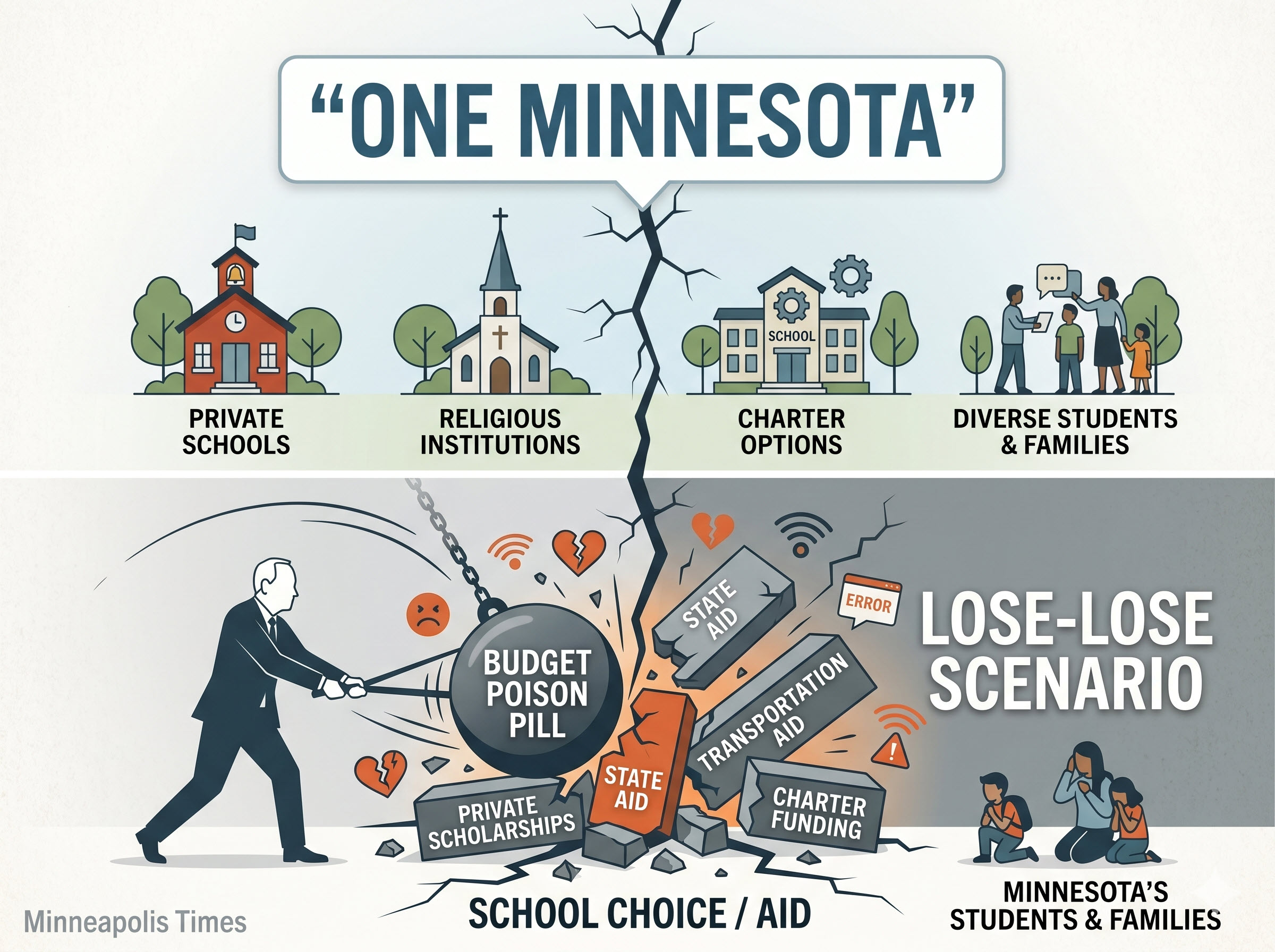
However, under Governor Tim Walz, this robust system is under attack. The most recent instance is the governor’s 2026 supplemental budget proposal, which includes a poison pill that directly targets educational pluralism: if Minnesota ever opts into the new Education Freedom Tax Credit Program (EFTC), the nation’s first federal private school choice program, all “nonpublic pupil aid and nonpublic transportation aid would be repealed.” Should the nonpublic aid be repealed, the savings would be redirected to the state-funded kindergarten program.
The EFTC, which was created by the “One Big Beautiful Bill,” will allow taxpayers to claim a credit of up to $1,700 for contributions to nonprofit organizations that fund private school scholarships and supplemental services for public school students. These scholarship-granting organizations will use the funds generated by the tax credit to help eligible families access K-12 educational options that might otherwise be out of reach financially.
However, there is a catch. The EFTC program becomes operative only in states that affirmatively elect to participate. Governor Walz has already declared that Minnesota will “never” opt into the EFTC. This is not a surprise—Governor Walz has been a consistent opponent of private school choice. The politics, here, are deeply troubling.
In light of his disagreements, Governor Walz could have simply refused to opt into the EFTC. Instead, the governor chose to weaponize his supplemental budget: The moment Minnesota opts into a federal program designed to help families in nonpublic schools, the state-level aid those schools depend on is stripped away.
Furthermore, even if Minnesota never opts in, the state’s taxpayers can still claim the available tax credits. Their donations, however, would then fund scholarships for students who live in other states. Accordingly, non-Minnesotans would be the beneficiaries.
Ultimately, the governor has manufactured a lose-lose scenario for Minnesota’s nonpublic schools. Rejecting the EFTC means forfeiting millions of in-state charitable contributions that would otherwise fund scholarships. Accepting the EFTC means surrendering the state-level aid those schools have relied on for half a century. Either way, the schools, families, and students of Minnesota suffer.
Unfortunately, this is not Governor Walz’s first attempt at gutting Minnesota’s private schools.
In January 2025, Governor Walz proposed a $109 million reduction in nonpublic pupil education aid and a separate elimination of nonpublic pupil transportation aid. The plan also included cutting $40 million from facilities and special education budgets at charter schools. School leaders and families began sounding the alarm, including hundreds protesting at the State Capitol building. Eventually, the proposed cuts were nixed from the budget.
In May 2023, Walz signed the PSEO amendment, which banned faith-based universities from offering free college credit to high school students. The religious animus in these efforts was clear. The Minnesota Department of Education had lobbied for this exclusion in four straight legislative sessions, actively tracked the effort as the “Northwestern issue,” and told Walz’s office that the 2023 bill delivered a policy the department had “sought for years.” However, in August 2025, Judge Nancy Brasel struck down the amendment.
In the end, Walz’s efforts to undercut educational pluralism unfairly and unwisely deprives Minnesota families of high-quality educational options, including access to private schools that have long served them well. In Minnesota, private schools serve over 80,000 students. It can hardly be doubted that Minnesota’s children would suffer—and along with them, the state’s vital interest in education—if the state’s nonpublic school aid were to go away. By contrast, the scholarships generated by the EFTC would benefit Minnesota’s children and families.
Governor Walz campaigned and governed under his banner of “One Minnesota.” However, his agenda tells a very different story. At every turn, the supposed unifier pushes to tear down the pluralist tradition that generations of Minnesotans built. The families and students of Minnesota deserve better.
