
Dismantling the entire Department of Homeland Security in the name of political resistance is a blueprint for national and economic vulnerability.
Like anyone who’s followed public policy for several decades, I have seen plenty of political slogans capture the public imagination. Usually, these slogans are designed to be loud, simple, and emotionally charged. They look great on a protest sign, but they rarely survive a basic encounter with the machinery of a functioning society.
For the past few years, the phrase “Abolish ICE” has been a standard rallying cry on the activist left. But in the newly published political platform of the Twin Cities Democratic Socialists of America (DSA), the authors have taken this concept and pushed it to its absolute radical conclusion. They aren’t just calling for immigration reform; they are demanding that we:
“Abolish ICE and the entirety of the Department of Homeland Security and Resist Fascism.”
To anyone who has ever sat in a national security briefing, managed a logistics supply chain, or coordinated emergency management, this demand reads less like a serious policy proposal and more like a blueprint for structural chaos.
The Department of Homeland Security (DHS) was created in the painful, clear-eyed aftermath of September 11, 2001. It was established for a very specific reason: the 9/11 Commission found that America’s premier law enforcement and intelligence agencies were operating in completely isolated silos, failing to share critical information that could have prevented a tragedy. DHS was built to unify 22 separate domestic agencies under one umbrella to protect the homeland.
To demand the total abolition of this entire cabinet-level department under the catch-all banner of “resisting fascism” is to completely misunderstand what DHS actually does every single day. This isn’t just about immigration enforcement. If you pull the thread on DHS, you dismantle everything from our cyber defenses and maritime rescue operations to commercial aviation safety and natural disaster relief.
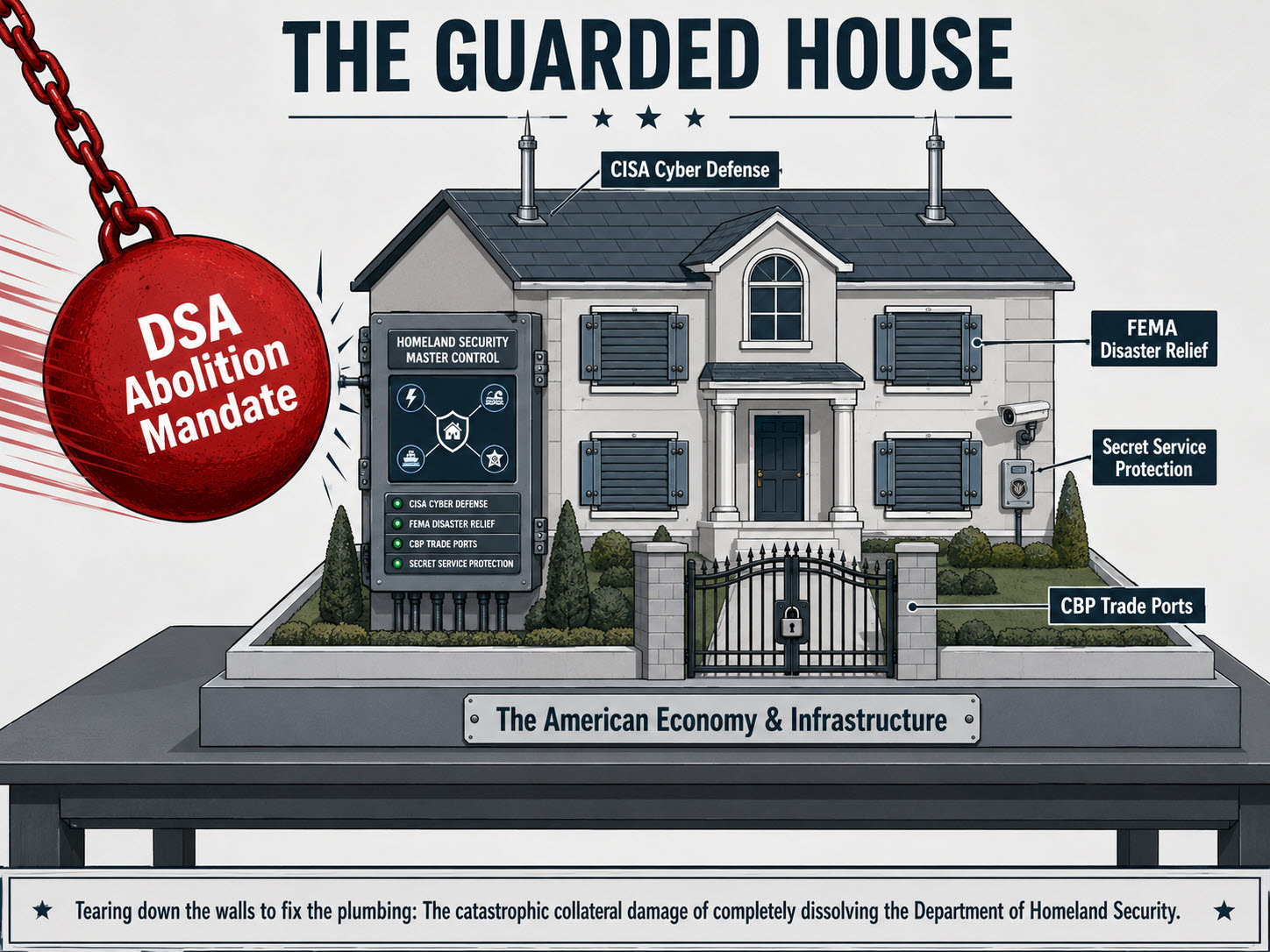
Let’s look past the activist vocabulary and perform a cold, systematic audit of what happens if you actually dissolve the core components of the Department of Homeland Security.
The Agency-by-Agency Fallout of Total Dissolution
1. Cybersecurity and Infrastructure Security Agency (CISA)
-
The Role: CISA is the nation’s defense shield against foreign cyber warfare. It is responsible for protecting our country’s critical infrastructure—meaning our electrical grids, municipal water treatment systems, nuclear power operations, banking networks, and election infrastructure—from sophisticated state-sponsored cyberattacks originating from adversaries like Russia, China, and Iran.
-
The Impact of Abolition: Abolishing CISA would instantly leave our public utilities and financial systems blind and unguarded in the digital theater. Without a centralized federal hub coordinating cyber defense with private utility companies and local governments, a foreign adversary could take down a regional power grid or compromise a metropolitan water supply with a keystroke, leaving millions of Americans in the dark without a federal countermeasure.
2. Federal Emergency Management Agency (FEMA)
-
The Role: FEMA is the lifeblood of domestic disaster response. When a tornado rips through Western Minnesota, a hurricane decimates the Gulf Coast, or historic floods swamp the Midwest, FEMA coordinates the entire federal response, deploying emergency housing, clean water, medical supplies, and billions of dollars in rapid rebuilding grants.
-
The Impact of Abolition: If you erase FEMA, you leave state and local governments entirely isolated when natural disasters strike. A city like Minneapolis or a rural Minnesota county does not possess the capital or the logistical supply chains to handle a catastrophic weather event alone. Abolishing this agency means that when the next major flood or tornado hits, emergency relief would be delayed for weeks or months while Congress bickers over ad-hoc funding bills, leaving displaced families stranded in the ruins of their communities.
3. Transportation Security Administration (TSA)
-
The Role: Love them or hate them at the airport terminal, the TSA is responsible for securing the nation’s commercial aviation and mass transit systems. They screen over two million passengers a day, ensuring that weapons, explosives, and high-tech threats never make it into the cabin of a commercial airliner.
-
The Impact of Abolition: Abolishing the TSA would mean returning to the pre-9/11 era of decentralized, low-bid private security firms managing airport checkpoints. Commercial aviation would immediately become a soft target for global terrorism once again. The resulting collapse in consumer confidence would paralyze global travel, cripple the airline industry, and inflict catastrophic damage on international commerce and tourism.
4. U.S. Customs and Border Protection (CBP)
-
The Role: CBP is the largest federal law enforcement agency in the country. While activists focus heavily on the Border Patrol component between ports of entry, CBP’s primary day-to-day mission is facilitating and regulating lawful international trade and travel. They manage every single port of entry, airport customs desk, and shipping harbor in the United States, inspecting millions of cargo containers daily to prevent the entry of illegal contraband, weapons, and agricultural pests.
-
The Impact of Abolition: Dissolving CBP would bring international trade to a grinding halt. Without customs officers to inspect and clear cargo, global supply chains would instantly freeze. Ships would sit stranded off the coasts, and cargo planes would remain grounded. The American economy would face immediate shortages of everything from manufacturing components to fresh food, triggering an economic depression. Furthermore, the absolute absence of border management would create an open pipeline for illicit weapons and unchecked contraband.
5. U.S. Immigration and Customs Enforcement (ICE)
-
The Role: While political rhetoric focuses exclusively on the Enforcement and Removal Operations (ERO) division, ICE also houses Homeland Security Investigations (HSI). HSI is a massive, elite federal investigative unit that targets transnational criminal organizations. They specialize in dismantling international human trafficking rings, shutting down child exploitation networks, tracking global money laundering, and interdicting the illicit flow of deadly synthetic narcotics like fentanyl.
-
The Impact of Abolition: Abolishing ICE doesn’t just stop deportations; it completely defunds the global fight against the worst elements of human criminality. Dismantling HSI would hand a massive victory to international drug cartels and human trafficking rings, who would suddenly find themselves operating without the threat of a specialized, deeply funded federal task force tracking their interior networks, illicit bank accounts, and digital footprints.
6. United States Coast Guard (USCG)
-
The Role: The Coast Guard is a unique, multi-mission military and law enforcement service. They patrol America’s 95,000 miles of coastline and the Great Lakes, performing thousands of maritime search-and-rescue operations every year, maintaining navigational aids for commercial shipping, protecting marine environments from oil spills, and executing high-seas drug interdictions.
-
The Impact of Abolition: Erasing the Coast Guard would leave our maritime borders completely exposed and our shipping lanes undefended. Commercial mariners and recreational boaters would have no federal safety net when disasters occur at sea. Furthermore, our coastal waters would become an unmonitored highway for drug smuggling operations and unregulated, destructive foreign fishing fleets.
7. U.S. Citizenship and Immigration Services (USCIS)
-
The Role: USCIS is the bureaucratic engine that administers the nation’s lawful immigration and naturalization system. They process green cards, work visas, student permits, citizenship applications, and legal asylum claims for millions of individuals trying to come to America the right way.
-
The Impact of Abolition: The absolute irony of the DSA’s demand is that abolishing DHS would destroy the very agency responsible for welcoming legal immigrants. Dissolving USCIS would instantly freeze the legal immigration system. Millions of lawful applicants, high-skill workers, refugees, and families seeking reunification would be trapped in a permanent legal limbo, unable to adjust their status, secure work authorization, or fulfill their dreams of becoming American citizens.
8. United States Secret Service (USSS)
-
The Role: The Secret Service has a dual mandate: protecting the President, Vice President, foreign heads of state, and major presidential candidates, while simultaneously investigating financial crimes, cyber fraud, and the counterfeiting of United States currency.
-
The Impact of Abolition: Dissolving this agency creates an immediate, highly dangerous security vacuum at the highest levels of the executive branch. Furthermore, stripping away the federal government’s primary defense against currency counterfeiting and large-scale digital banking fraud would fundamentally undermine global confidence in the stability and security of the U.S. dollar.
                  ┌─────────────────────────────────────────┐
                  │  Twin Cities DSA Platform: Abolish DHS  │
                  └────────────────────┬────────────────────┘
                                       │
         ┌─────────────────────────────┼─────────────────────────────┐
         ▼                             ▼                             ▼
  [Defense Vacuum]             [Economic Collapse]           [Humanitarian Crisis]
  • CISA: Power grids exposed  • CBP: Ports & trade freeze   • FEMA: No federal disaster aid
  • TSA: Aviation open to risk • USCG: Coastlines unguarded  • USCIS: Legal immigration stops
  • USSS: Executive unprotected• ICE: Cartels face no interior checks
Conclusion: The Danger of the Informational Silo
When you step back and evaluate the Department of Homeland Security as a cohesive unit, you realize that the DSA’s demand is a manifestation of a dangerous political impulse: the desire to destroy an entire house simply because you dislike the color of one of its rooms.
If you believe that immigration policies need greater oversight, human rights protections, or structural adjustments, you introduce targeted legislation to reform those specific protocols. You do not blindfold our cyber defenses, paralyze our international trade, grounded our commercial flights, and abandon our communities to natural disasters.
As someone who remembers the profound institutional failures that led to 9/11, I find the prospect of deliberately returning to an era of fragmented, un-coordinated intelligence and law enforcement terrifying. Abolishing DHS would force the remaining remnants of these agencies back into their isolated silos, creating the exact vulnerabilities that our adversaries look to exploit.
True public policy wisdom lies in refining the tools of governance to better protect both security and civil liberties—not in smashing the very architecture that prevents a modern society from sliding into vulnerability and chaos. In our next column, we will apply this same realistic focus to another pillar of the platform.
Article Reference List
-
Democratic Socialists of America Platform: Twin Cities DSA. (2024). Twin Cities DSA Party Platform. Retrieved from the Minneapolis Times Archive.
-
DHS Historical Creation and Structural Overview: The National Commission on Terrorist Attacks Upon the United States. (2004). The 9/11 Commission Report. Official baseline documenting the communication failures of isolated intelligence silos and the statutory necessity for a unified Department of Homeland Security. Available via the National Archives and Records Administration.
-
Cybersecurity Infrastructure and Defenses: Cybersecurity and Infrastructure Security Agency. (2025/2026). CISA Strategic Plan and Critical Infrastructure Risk Management Brief. Data detailing the federal defense of utility grids, municipal water networks, and electoral frameworks can be accessed through the Cybersecurity and Infrastructure Security Agency Digital Library.
-
Domestic Disaster Emergency Response Tracking: Federal Emergency Management Agency. (2026). FEMA Annual Disaster Relief Fund Expenditures and Logistical Summaries. Reviewing federal asset deployment and municipal recovery metrics across midwestern weather systems via the Federal Emergency Management Agency Data Portal.
-
Transnational Crime and Investigative Analytics: U.S. Immigration and Customs Enforcement. (2025). Homeland Security Investigations (HSI) Annual Operations Report: Human Trafficking, Narcotics, and Child Exploitation Metrics. Documenting interior cartel network interventions and specialized task force outcomes through the U.S. Immigration and Customs Enforcement Freedom of Information Act Reading Room.
-
International Ports of Entry and Trade Volume Records: U.S. Customs and Border Protection. (2026). CBP Trade and Travel Report: Facilitating Lawful Commerce. Actuarial counts regarding cargo inspections, supply chain security, and port-of-entry logistics can be verified through U.S. Customs and Border Protection Performance Metrics.
-
Maritime Border Enforcement and Search and Rescue Metrics: United States Coast Guard. (2025). U.S. Coast Guard Posture Statement and Maritime Safety Statistics. Reviewing drug interdiction volumes and commercial shipping lane safety metrics via the United States Coast Guard Home Portal.
Related: The Socialist Agenda: What the Twin Cities DSA Demands for the State’s Future

With all the mass firings of our experts in every department of Homeland Security, it looks like the trump administration is doing dsa’s work for them.
Domonoske, Camila. “50 Years Ago, Sugar Industry Quietly Paid Scientists To Point Blame At Fat.” NPR News, 13 Sept. 2016