
Here we go again: the equity wagon-wheel of not seeing the opportunity presented to us every school year.
Every Minnesotan knows the danger of black ice. The road can look perfectly ordinary. The pavement appears dry, traffic continues moving, and nothing visible tells the driver that the surface beneath the tires has changed. Then, without warning, traction disappears. By the time the danger becomes obvious, the vehicle may already be sliding toward the ditch.
Minnesota has Black Ice in its public education system, and unlike the frozen hazard on Interstate 94, this version cannot be treated with salt. It exists within institutions, policies, expectations, funding decisions, accountability systems, school districts, state agencies, and ultimately the highest levels of Minnesota government. It forms wherever persistent racial disparities become so familiar that adults learn to explain them instead of eliminating them. It becomes especially dangerous when an educational system can describe itself as equitable, progressive, inclusive, and well-funded while generations of Black and American Indian children continue producing outcomes that should be considered a statewide emergency.
The metaphor is uncomfortable because the data are uncomfortable.
From December 2025 through February 12, 2026, Minnesotans watched Operation Metro Surge unfold across the Twin Cities. Thousands of federal immigration-enforcement personnel descended on Minnesota, disrupting neighborhoods, businesses, schools, workplaces, and families. Minnesota Attorney General Keith Ellison challenged the operation in federal court, while public officials condemned allegations of racial profiling and the effects of aggressive enforcement on communities. When Ellison announced the operation’s conclusion, his office specifically referenced Minnesotans who feared leaving their homes, businesses that suffered, children whose schooling was disrupted, and workers who lost income.
Whatever one’s politics surrounding federal immigration enforcement, there is an important lesson in Minnesota’s response. When political leaders perceived an immediate threat to vulnerable communities, government knew how to sound the alarm. Officials collected evidence, filed lawsuits, held press conferences, demanded accountability, mobilized organizations, gathered impact data, and described the situation with the urgency they believed it deserved.
That raises an uncomfortable question: Where is that same urgency for the Black and American Indian children who have been academically sliding across Minnesota’s educational Black Ice for decades?
For this conversation, ICE has another meaning: **Inequity, Compliance, and Excuses**. Inequity permits radically different outcomes for children attending schools within the same public system. Compliance allows institutions to confuse following procedures with producing results. Excuses provide sophisticated explanations for why unacceptable academic outcomes must continually be studied, contextualized, funded, renamed, and studied again, rather than fundamentally disrupted.
This Black Ice is difficult to see because Minnesota’s educational machinery continues to function. School buses arrive every morning. Teachers enter classrooms and work extraordinarily hard. Principals manage complicated buildings. Superintendents present strategic plans. School boards approve budgets. Legislators hold hearings. Consultants deliver presentations. Foundations announce initiatives. Equity offices conduct trainings. Universities prepare new educators. The Minnesota Department of Education publishes reports. Billions of dollars move through the system, and from a distance the highway appears open.
Then we look at the children.
Saint Paul Public Schools reports overall proficiency of approximately 34.8 percent in reading and 26.5 percent in mathematics. Its published graduation information reports a 2025 four-year graduation rate of 71.3 percent for Black students and 61.1 percent for American Indian students, compared with 88.8 percent for White students. These numbers are not remnants of some discriminatory educational system from fifty years ago. They belong to modern, progressive, equity-conscious Minnesota.
There has been progress, and intellectual honesty requires acknowledging it. Minnesota reached a record statewide four-year graduation rate of 84.9 percent in 2025. Black students improved to approximately 76.4 percent, and American Indian students made a substantial gain to 67.6 percent. Those improvements represent real young people crossing graduation stages, and they deserve recognition.
But progress cannot become camouflage.
A 67.6 percent graduation rate also means that roughly one-third of American Indian students did not graduate within four years. A 76.4 percent Black graduation rate remains substantially below the rate for White students. Minneapolis Public Schools presents an equally complicated picture. Its overall four-year graduation rate for the Class of 2025 was approximately 73 percent. Black students improved to 69 percent, while American Indian students increased dramatically from 46 percent to 58 percent. A twelve-point improvement deserves attention, but so does the number that remains: 58 percent. If only 58 of every 100 American Indian students represented by that rate graduate in four years, no serious educational institution should describe the remaining disparity as anything other than an emergency.
This is where Minnesota must resist one of its most dangerous habits: celebrating incremental improvement without confronting the scale of the underlying failure. Moving from catastrophic to deeply troubling is movement, but it is not success. When approximately two-thirds of students in a major urban district are not demonstrating reading proficiency and nearly three-quarters are not demonstrating mathematics proficiency, the public should not be satisfied with language about “moving in the right direction.” Direction matters, but eventually a school system must arrive somewhere.
The situation of Black and American Indian boys deserves even greater scrutiny. Yet here Minnesota encounters another form of Black Ice: the data families need are not always presented in the intersectional form necessary to understand what is happening. It is not enough to tell us how “Black students” perform. We need to know how Black boys perform. It is not enough to publish outcomes for “American Indian students.” We need to know what is happening to American Indian boys. Those numbers should be connected to reading, mathematics, attendance, discipline, special education, advanced coursework, graduation, career preparation, college enrollment, and postsecondary completion.
Minnesota should be able to answer a simple question in 2026: What percentage of Black boys and American Indian boys in every major public school district can read and perform mathematics at grade level?
Parents should not need a doctorate, a data analyst, three government websites, and an afternoon of spreadsheet manipulation to find the answer.
This brings us to a phrase that will make some people uncomfortable: social engineering without accountability. I am not suggesting that educators gather in secret rooms plotting the failure of Black children. Such a claim would be absurd and would distract from the much more serious problem. Institutional failure rarely requires conspiracy. It requires something far more ordinary: systems that develop routines, incentives, language, funding structures, and professional cultures that gradually make unacceptable outcomes feel normal.
Low expectations can be repackaged as compassion. Moving students forward without mastery can be described as a form of support. Chronic absenteeism becomes another dashboard. Racial achievement disparities become permanent features of strategic plans. Another intervention becomes innovation. Another consultant becomes expertise. Another committee becomes action. Another grant becomes investment. Another conference becomes progress.
The vocabulary changes while the child’s reading level does not.
This is why the phrase “achievement gap” has become almost too polite for what the numbers describe. A gap sounds passive, as if two groups of children simply wandered apart. But educational outcomes are produced inside systems. Children experience curriculum, instruction, expectations, discipline, attendance policies, teacher quality, school culture, leadership decisions, family engagement, funding priorities, and countless institutional choices. When racial disparities remain predictable year after year, leadership must stop treating them as mysterious.
Black children are not intellectually deficient, and American Indian children are not incapable of academic excellence. Black boys are not naturally disruptive. American Indian boys are not destined for disengagement. Poverty does not erase intelligence, disability does not eliminate potential, and a ZIP code is not a cognitive assessment. Minnesota must therefore stop beginning this conversation with what is supposedly wrong with children and start examining what adults have built around them.
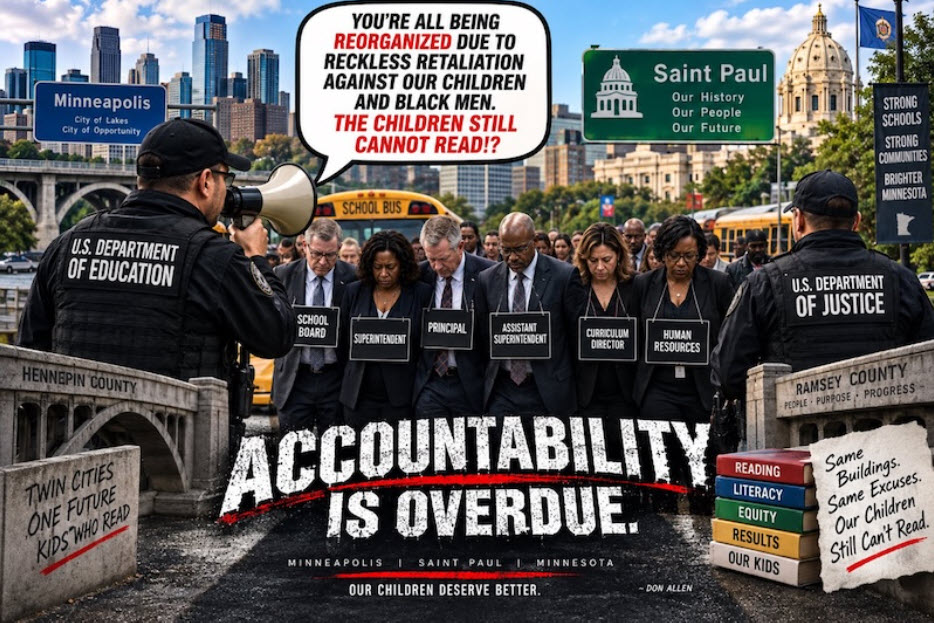
The accountability must extend far beyond classroom teachers. Teachers work inside systems they did not create and frequently struggle against conditions they cannot control. Responsibility belongs throughout the structure: principals, superintendents, school boards, unions, teacher-preparation programs, universities, nonprofit organizations, foundations, the Minnesota Department of Education, the Legislature, and the executive branch. If racial disparities survive superintendent after superintendent, strategic plan after strategic plan, commissioner after commissioner, and multimillion-dollar initiative after multimillion-dollar initiative, then Minnesota no longer has an isolated personnel problem. Minnesota has a systems problem.
That system requires disruption, but disruption should not be confused with chaos. Minnesota does not need theatrical mass firings, another organizational rebranding, or a new slogan printed on banners hanging inside schools. It needs deliberate disruption of practices that repeatedly produce unacceptable results. Every major district should publish understandable academic dashboards disaggregated by race and sex, with additional breakdowns by disability, income, and other relevant categories where privacy protections permit. Third-grade reading, middle-school mathematics, chronic absenteeism, disciplinary exclusion, graduation, advanced coursework, career preparation, and postsecondary readiness should be easily visible to parents and taxpayers.
Schools serving large numbers of Black and American Indian students should receive the resources necessary to succeed, but additional resources must be connected to measurable academic expectations. Programs that work should be expanded. Programs that repeatedly fail should be redesigned or ended, regardless of how fashionable their terminology sounds. Minnesota should aggressively recruit and retain excellent Black and American Indian teachers, particularly men, while simultaneously insisting on deep content knowledge, instructional skill, cultural competence, classroom leadership, and high expectations for every student.
Most importantly, Minnesota must stop confusing money spent with children educated. Expenditures are inputs. Consultants are inputs. Professional-development conferences are inputs. Equity plans are inputs. New administrative positions are inputs. Grants, committees, strategic plans, task forces, listening sessions, curriculum purchases, and public-relations campaigns are all inputs. They may be necessary, useful, or even transformative, but none of them constitutes an educational outcome.
A Black boy reading proficiently is an outcome. An American Indian boy mastering algebra is an outcome. A student writing a coherent analytical essay is an outcome. A teenager standing before an audience and defending an argument with evidence is an example of an outcome. A graduate entering college without remediation is an outcome. A young person entering a skilled trade with the mathematics necessary to succeed is an outcome. A student leaving high school prepared to build a business, participate intelligently in democracy, support a family, and navigate an increasingly technological economy is an outcome.
Minnesota has spent too many years applauding the inputs.
That is why the Black Ice metaphor matters. The greatest institutional dangers are not always the ones accompanied by sirens. Sometimes danger becomes invisible precisely because everyone has learned how to drive around it. Minnesota has lived with racial educational disparities for so long that numbers capable of provoking outrage in almost any other context now arrive as another annual news release. We compare this year’s percentage with last year’s percentage, celebrate a point here or mourn a point there, announce another initiative, and continue down the highway.
Imagine if Minnesota responded differently. Imagine the governor, Legislature, school boards, superintendents, universities, foundations, parents, and community organizations treating third-grade reading failure among Black children with the urgency of a statewide emergency. Imagine American Indian boys’ mathematics achievement triggering the same institutional mobilization that accompanies other threats to vulnerable communities. Imagine every dollar allocated to an equity initiative being tracked from appropriation through implementation to measurable student outcomes. Imagine asking not merely whether a program was delivered, but whether children became better readers, writers, thinkers, speakers, mathematicians, and problem-solvers because it existed.
That would be accountability.
Operation Metro Surge demonstrated that Minnesota’s institutions can mobilize rapidly when leaders believe communities face immediate danger. Evidence can be collected. Lawsuits can be filed. Emergency resources can be deployed. Political leaders can demand answers. Government can move quickly when maintaining the status quo becomes morally and politically unacceptable.
The children trapped on Minnesota’s educational Black Ice deserve that same sense of urgency.
The road has looked normal for too long. The buses are still moving, budgets are still being approved, meetings are still being held, and adults are still producing sophisticated explanations for persistent disparities. Yet underneath that familiar institutional traffic are Black and American Indian children whose outcomes tell us that traction has already been lost.
We cannot continue blaming the passengers. We cannot keep admiring the vehicle. We cannot commission another study of the road while another generation slides toward the ditch.
The data have made the Black Ice visible. Minnesota now has a choice: fundamentally change the conditions that keep producing predictable racial disparities, or continue managing those disparities while calling the management progress.
Our children deserve more than that. They deserve an educational system unwilling to become comfortable with their failure, unwilling to lower expectations in the name of compassion, and unwilling to accept another generation of predictable outcomes.
Black Ice is most dangerous when nobody sees it coming.
Minnesota can no longer make that excuse.
We see it now.
— Don Allen
Sources
Kats, R. (2019, March 28). Disparities based on race and disability status persist in school discipline. Session Daily, Minnesota House of Representatives. Minnesota House article
Minneapolis Public Schools. (2026). MPS celebrates four-year graduation rate increases. Minneapolis Public Schools graduation data
Minnesota Department of Education. (n.d.). Use statewide assessment results. Minnesota statewide assessment results
Minnesota Department of Education. (2025). Increasing the number of teachers of color and American Indian teachers in Minnesota. Minnesota Department of Education.
Minnesota Department of Education. (n.d.). American Indian student achievement report. Minnesota Department of Education.
Minnesota Department of Education. (n.d.). American Indian student counts and identification. Minnesota Department of Education.
Minnesota Department of Education. (n.d.). Authorizer performance: Academic performance framework. Minnesota Department of Education.
Minnesota House of Representatives. (2019). Education gaps at a glance. Minnesota House of Representatives.
Minnesota Legislature. (n.d.). Achievement and integration program: Institutional inequities and educational disparities. State of Minnesota.
Saint Paul Public Schools. (2026). Saint Paul Public Schools’ reading and math scores tick upward. Saint Paul Public Schools.
