
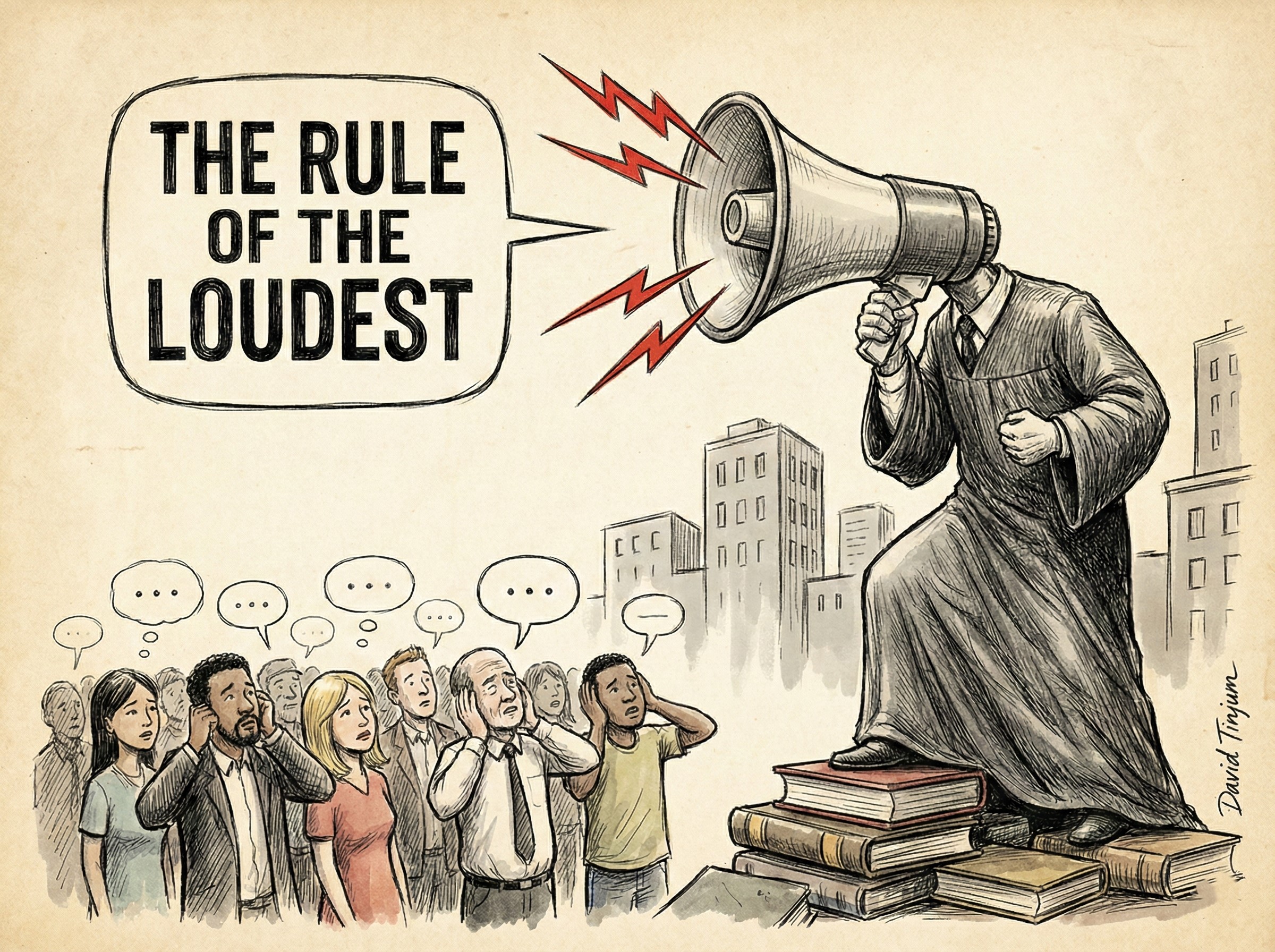
The First Amendment is often described as the “crown jewel” of the American experiment. It protects the right to speak, to assemble, and to petition the government for a redress of grievances. But in recent years, a dangerous misconception has taken root in our civic discourse: the idea that the right to “free speech” includes the right to silence others, even within the walls of their own private institutions.
A stark example of this misunderstanding recently unfolded at Cities Church in St. Paul. Protesters, fueled by a grievance against an Immigration and Customs Enforcement (ICE) official affiliated with the church, chose to enter the sanctuary and disrupt a religious service. While the protesters may have felt their cause was righteous, their methods were legally illiterate and ethically indefensible. As a matter of constitutional law and civic necessity, we must be clear: The First Amendment is a shield for the citizen against the state; it is not a sword to be used to pierce the sanctity of a private assembly.
To understand why these actions cross a line, one must look at the legal framework so clearly outlined by constitutional advocates representing all faiths, including Christian, Jewish and Muslim beliefs. The First Amendment protects us from government censorship. It does not grant a “heckler’s veto” that allows a private citizen to commandeer a pulpit or drown out a choir.
First, there is the fundamental distinction between public and private forums. A public park or a sidewalk is a traditional public forum where the government’s power to restrict speech is at its lowest. A church, however, is private property. Just as a citizen has no First Amendment right to stand in your bedroom and shout political slogans while you try to sleep, a protester has no constitutional right to occupy a pew and disrupt a liturgy. Property rights are not suspended because a protester feels passionate about immigration policy. When protesters refuse to leave private property or intentionally disrupt the lawful activities occurring there, they are not “exercising their rights”—they are committing trespass and disturbing the peace.
Second, we must consider the “Free Exercise” clause. The First Amendment does not just protect speech; it protects the right of religious communities to worship without interference. When a mob—no matter how well-intentioned—enters a house of worship to prevent a service from proceeding, they are infringing upon the religious liberty of every person in those pews. The law recognizes this. In Minnesota, as in many other states, there are specific statutes that criminalize the disruption of religious services. These laws are not “anti-speech”; they are “pro-liberty.” They ensure that a community can gather to seek the divine without being held hostage by the political whims of the day.
Furthermore, there is a logistical reality to the First Amendment: for speech to be free, it must be orderly. If every person had a “right” to interrupt every other person, no one would ever be heard. Constitutional law allows for “time, place, and manner” restrictions. You can protest ICE on the sidewalk outside the church. You can hand out flyers on the public way. You can hold signs in the park across the street. But you cannot walk into a private ceremony and demand that your voice be the only one heard. That is not a “vibrant democracy”; it is the rule of the loudest.
The disruption at Cities Church is part of a broader, more worrying trend of “performative disruption.” We see it in libraries, in lecture halls, and now in churches. It is born of a belief that the urgency of one’s cause justifies the suspension of civil norms. But this is a double-edged sword. If we normalize the disruption of church services because of an ICE official’s presence, we must also accept the disruption of a synagogue because of a policy in the Middle East, or the disruption of a mosque because of a disagreement over secular law. Once we concede that the sanctuary is a legitimate battleground for political theater, we lose the very “quiet spaces” that make a pluralistic society possible.
We can—and should—debate immigration policy. We should hold our government officials accountable. But we must do so in a way that respects the boundaries of the law and the rights of our neighbors. The protesters in Minnesota did not vindicate the First Amendment; they ignored its most basic tenets.
True “freedom of speech” requires the discipline to allow others to speak—and pray—in peace. The sanctuary of a church should remain exactly that: a place of refuge from the cacophony of the political world, protected by a Constitution that understands that rights are only as strong as the boundaries that define them. To those who wish to change the world: By all means, take to the streets. But leave the pews to the faithful.

Your article is clear and on point about first amendment and freedom of religion, regardless of whether the pastor with ICE affiliation was present, and whether or not he has Nazi ties. I really like the phrase “performative disruption,” and I agree that the disruption is ethically indefensible as well as illegal.
What if the pastor who’s service I’m interrupting is a nazi or nazi apologist? Can I protest him then?
Every story I’ve read from mainstream media has stated the pastor who is an ICE employee was not conducting the service. I think it was mentioned that he was not in the building.
I’ve not seen any suggestion that the ICE employee in question was a nazi.
I think if you’re running the st. Paul operations for ICE you’re likely a nazi or comfortable working with and hiring nazis.
David! Please! Go ahead and answer the question he asked! It’s a stupid question, but if one is going to answer a stupid question at all, one should answer it honestly.
The answer to the question he asked is simply “No. Not IN the Church. Not by disrupting their worship service.” Geez, with all the things in life that are really, really complicated, if we are to understand AT ALL what the Founders meant by “Freedom of Religion” and “Freedom of Speech”, and to honor how important they both are, we need to acknowledge that THIS is NOT complicated. NEITHER of those freedoms is served by allowing a “heckler’s veto” INSIDE a church!
Thanks for the grounded take. “For speech to be free, it must be orderly.” 💯