
From Vietnam to the Twin Cities – The 50-Year Legal Legacy Behind ICE’s Surveillance Tactics.
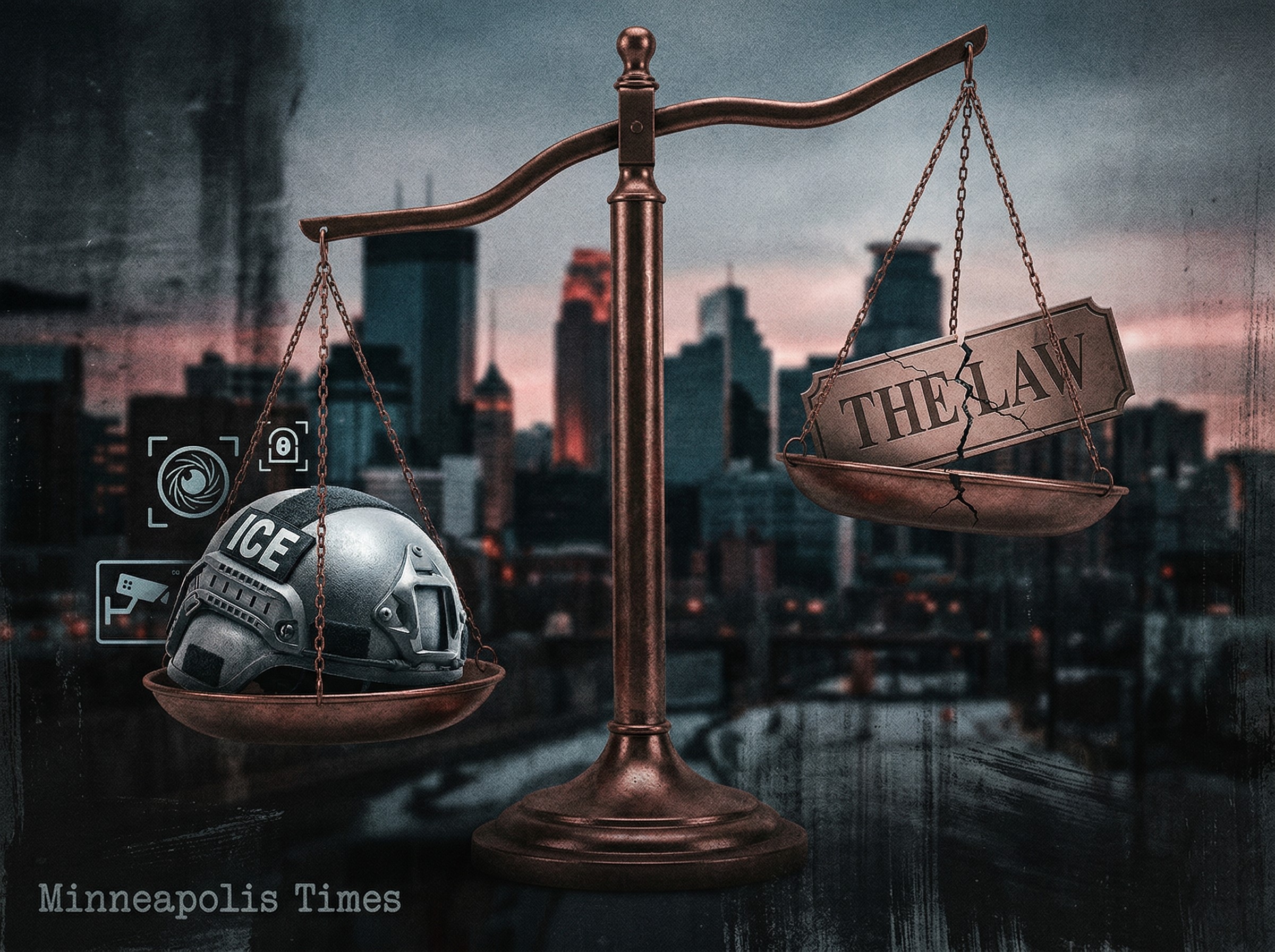
ICE agents have yet to be deployed at the Twin Cities International Airport during the partial government shutdown, despite their presence starting this week at about a dozen other flying facilities around the country. In light of what happened here this winter during the ICE onslaught, it may well be that—to paraphrase Shakespeare’s character Falstaff in Henry IV, Part II—their absence is the better part of valor.
But ICE’s continued, even somewhat scaled-back, presence harkens back to one of the many revelatory and odious features of “Operation Metro Surge” that permeated the Twin Cities and whose remnants continue to haunt the area: the varied surveillance techniques rolled out by ICE to create a database of protesters. This included the deployment of several new and novel state-of-the-art devices.
While the technology is new, the underlying concept is not. It is a tried-and-true method whose lineage has been upheld by the U.S. Supreme Court. ICE’s devices include mobile location tracking, cell phone location monitoring, telephone hacking, social media monitoring, facial recognition, eyeball iris scanning, and vehicle license plate readers, among others. These methods rely heavily on AI and often involve collusion with private sector companies. While initially aimed at immigration enforcement, ICE has expanded their use against critics and protesters, including those here in Minnesota.
Although the mechanisms are high-tech, their use and validation are traceable to the days of another corruption-challenged president: Richard Nixon.
Vietnam Validation
During the height of the Vietnam War protests in the early 1970s, the Nixon administration authorized a program through the Defense Department allowing the Army to engage in surveillance and intelligence-gathering regarding war critics, demonstrators, and other dissidents. The methods were quite antiquated by contemporary standards, consisting in large part of collecting newspaper clippings and taking photographs of protesters at anti-war demonstrations.
A group of citizens fearing they were being spied upon challenged the program, contending that it created a “chilling effect” on their ability to express their views in violation of their First Amendment rights. They brought a class action lawsuit against the Secretary of Defense, Melvin Laird. While the case was initially dismissed, it was reinstated by the federal appellate court for the District of Columbia.
In 1972, the case—Laird v. Tatum—reached the Supreme Court. The Court did not expressly endorse the arrangement, but it did validate its existence and its immunity from challenge. In a decision written by Chief Justice Warren Burger of Minnesota for a narrowly divided 5-4 Court, the appellate ruling was overturned, allowing the program to continue. The decision was joined by four of the Chief Justice’s conservative colleagues, including his “Minnesota Twin,” Harry Blackmun of Minnesota.
The Chief Justice wrote that the case was not maintainable because the aggrieved claimants only suffered a subjective “fear” that did not satisfy the legal requirement for “an objective harm or threat of specific future action.”
The defect with the decision, according to critics, was that the “chilling” requirement is, by definition, subjective. The dissenting justices, led by Justice William O. Douglas, deemed the decision “a cancer on the body politic.” The decisive vote was cast by William Rehnquist, another Nixon appointee. Rehnquist’s participation was controversial because he had been one of the principal architects of the program while working in the Justice Department before his appointment to the Court. Despite requests, he declined to recuse himself, a practice of judicial discretion that exists to this day.
Doubling Down
Fast forward nearly four decades, and the Supreme Court, with an even more conservative majority, doubled down on the Tatum ruling. In the 2013 case Clapper v. Amnesty International, the Court held that citizens lack “standing” to pursue claims of wrongful intrusion regarding government surveillance under the Foreign Intelligence Surveillance Act (FISA).
The Court in Clapper reasoned that there was no showing that the individuals had suffered an “injury in fact.” Justice Samuel Alito’s ruling held that concerns of improper intrusion were “conjectural” in the absence of specific facts demonstrating that their contacts would be targeted.
But critics say that is the rub. This kind of government surveillance—by ICE or other agencies—does not materialize into actual harm until the gathered data is used. By then, it is too late. Even without these precedents, the High Court likely would not intervene in an ICE surveillance dispute. With them, it is almost futile to ask the judiciary to prevent such intrusion.
Consequently, individuals protesting and resisting government excesses will likely have to contend with these tactics, which will beget amplified and expanded surveillance by ICE and its affiliates in Minnesota and beyond.

So, citizen protesters are concerned about their First Amendment rights, fearing that surveillance by a government agency gives them the “feeling” that they may, at some point in time, become disenfranchised and have their First Amendment rights removed, taken away, or otherwise negated.
Sounds a lot like the same kinds of concerns some citizens have regarding their Second Amendment rights.