
A friend of mine attended an informational session at the Minnesota Department of Education to review the Minnesota Department of Education’s newest masterpiece, the Guide to Flexible, Learner-Centered Options (2026), produced by the Career and College Success Division. Naturally, in a state where student proficiency rates continue to sag like an old folding chair at a church basement fish fry, the answer was not to intensify instruction, strengthen literacy, or demand higher academic performance. No, no. The solution, apparently, is to redefine the furniture.
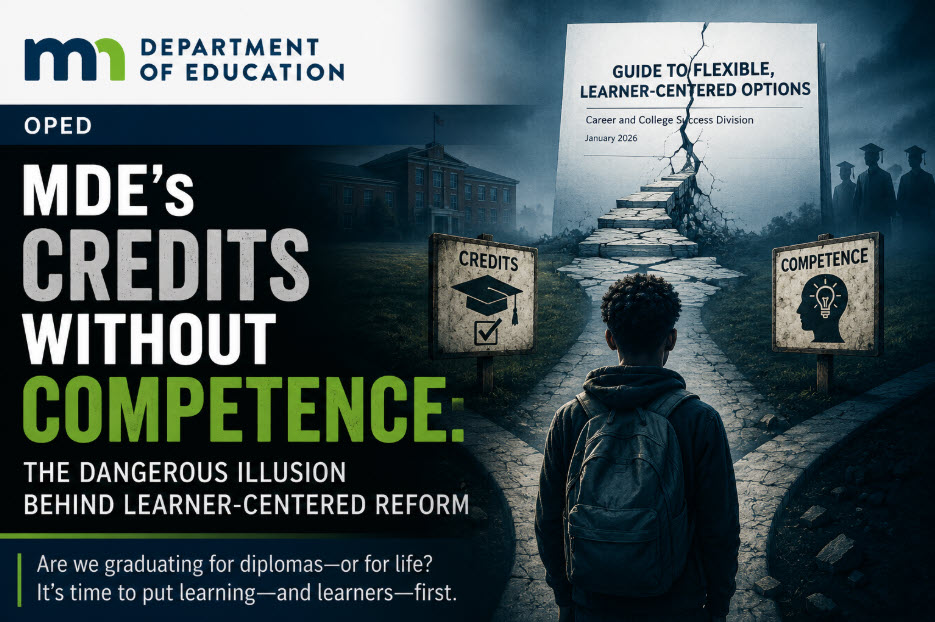
After reading the document in its entirety, I felt compelled to translate the bureaucratic poetry into plain English for ordinary people who still believe schools should primarily teach children how to read, write, think, and calculate at grade level. The guide is filled with the kind of polished educational language that sounds revolutionary right up until you realize it carefully avoids discussing whether students are actually proficient in anything.
Again, we are watching the cart get placed several miles ahead of the horse. Minnesota’s education establishment has apparently concluded that if enough pathways, flexibility, personalized pacing, competency language, and “learner-centered” branding are layered onto the system, nobody will notice that thousands of students still cannot consistently perform at grade level in reading or mathematics. It is the educational equivalent of repainting the dashboard while the engine smokes on the side of Interstate 94.
The document’s core weakness is that it treats flexibility as a solution before proving instructional effectiveness. In Twin Cities districts where proficiency is already low, flexibility can become a softer pathway around failure instead of a stronger pathway through it.
The guide promotes flexible pacing, competency-based credit recovery, self-directed learning, experiential credit, online learning, work-based learning, and multiple graduation pathways. Those ideas are not bad. The vulnerability is that the guide gives far more attention to access, compliance, scheduling, and credit accumulation than to reading, math, grade-level proficiency, intervention quality, and proof of mastery.
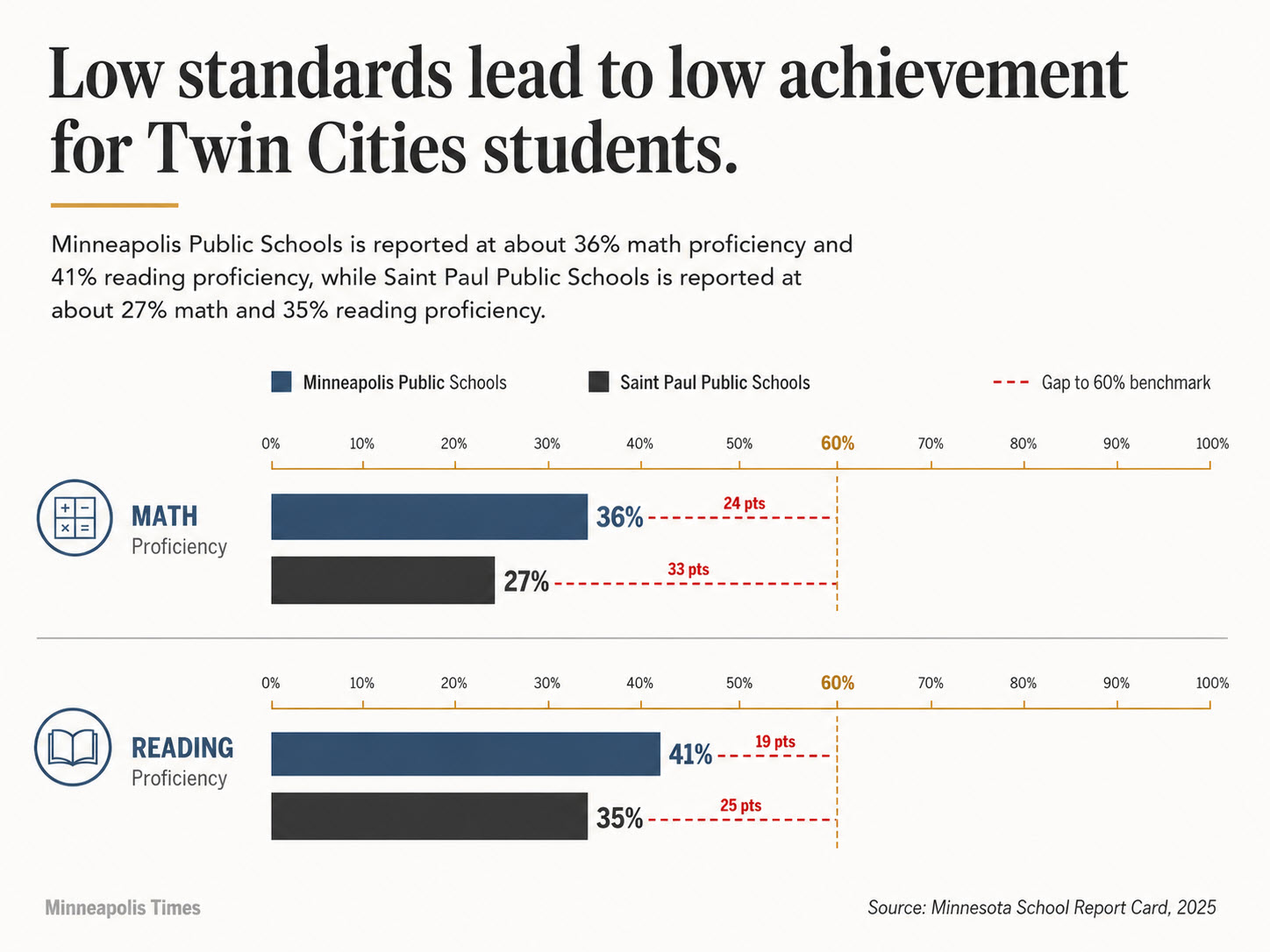
For Twin Cities students, that matters. Minneapolis Public Schools is reported at about 36% math proficiency and 41% reading proficiency, while Saint Paul Public Schools is reported at about 27% math and 35% reading proficiency. Statewide, fewer than half of Minnesota students are meeting grade-level expectations in math and reading (Minnesota School Report Card, 2025).
The biggest vulnerability is credit without competence. Page 10 says students may demonstrate standards “in a variety of ways,” and that educators use professional judgment to award credit. That sounds empowering, but in low-proficiency systems, it can become dangerous unless mastery is externally verified. A student may earn credit through projects, work experience, online coursework, or credit recovery while still being unable to read complex text, write analytically, or do grade-level math. That is not equity. That is credential inflation.
The Saint Paul credit recovery example is especially vulnerable. The guide says students begin at 0% and work toward a 60% passing threshold with flexible pacing and revision opportunities. In a district where proficiency is already low, a 60% threshold may recover credits without recovering learning. Credit recovery should not be judged by how quickly students regain credits; it should be judged by whether students later demonstrate proficiency on independent assessments, course-embedded common assessments, graduation indicators, and postsecondary outcomes (Minnesota School Report Card, 2025).
This critique should be done through a proficiency-first audit as diagnosed via the Theory of Corners Framework(Allen, 2025):
Compare every flexible option against MCA/MTAS reading, math, and science proficiency by district, school, grade, race, income, multilingual status, and disability status. Do not let graduation rate or credit completion substitute for academic competence.
Review the actual student work behind the credits. For project-based learning, experiential credit, and work-based learning, require common rubrics aligned to Minnesota standards are required, not just local teacher judgment.
Examine whether students in flexible pathways are disproportionately Black, Indigenous, low-income, multilingual, or special education students. If struggling students are being routed into lower-rigor alternatives, the system is reproducing inequality under the language of innovation.
Track outcomes after participation: Did reading improve? Did math improve? Did attendance improve? Did students pass future courses without needing more recovery? Did they persist in college, trades, military, or employment?
Bottom line: the document is useful as a policy flexibility guide, but it is weak as an academic improvement guide. In the Twin Cities context, the missing question is brutal but necessary: Does flexibility produce proficiency, or does it merely make low proficiency easier to manage?
Read the full document (PDF) here: https://education.mn.gov/mdeprod/groups/educ/documents/structure/cm9k/mdk4/~edisp/prod098719.pdf

Doesn’t take long to screw things up, but takes a long time to reverse course.
For districts that adopt both a strong knowledge-building ELA curriculum and a strong phonics curriculum, I suspect we’ll see meaningful improvement in 3rd grade MCA reading scores during the 2028-2029 school year, and that cohort will be in 4th grade during the 2029-2030 school year. I’d expect even greater gains in districts that also adopt strong edtech/screen time policies and have schoolwide practices that lead to calm classroom learning environments most of the time.
The problem is that not many districts will have all of those pieces in place. Thankfully, most have now adopted stronger phonics curriculum in K-2. But even with The READ Act, many districts still lack a high-quality Tier 1 ELA curriculum with a coherent scope and sequence that systematically builds students’ background knowledge in areas like history, science, and social studies. (Minneapolis Public Schools actually just adopted one called Arts and Letters, about time!) That type of broad knowledge is a major part of what helps students become strong comprehenders, which is necessary to achieve proficiency on the MCAs.
Don’t get me started with math.
@Rachb:
You wrote: “…many districts still lack a high-quality Tier 1 ELA curriculum with a coherent scope and sequence that systematically builds students’ background knowledge in areas like history, science, and social studies.” I’m an English teacher – the constructivist approach works well; I know this to be a fact. There’s only a handful of superintendents who understand this. Unfortunately, they work in school districts outside of the Twin Cities, where MCAs come back 70–100% for students enrolled. Thank you for being clear and nuanced.
I think we’re on the same page, but perhaps you have a different working definition of the constructivist approach?
What I described above is not the constructivist approach (also known as inquiry, discovery, project-based, competency-based learning, whatever the buzzword de jour of the day is), but most MN educational leaders, even those in the burbs and outstate, subscribe to this approach as the main form of Tier 1 instruction.
The most recent updates of the Minnesota Academic Standards in Math, Science, and Social Studies are heavily inquiry-coded, which doesn’t help anything, because districts think they are forced to adopt inquiry-based curriculum and primarily use inquiry-based instruction to meet the new inquiry-coded standards. Despite state statute indicating that academic standards “must not require a specific teaching methodology or curriculum.”
This type of heavy-handed inquiry-based instruction disproportionally impacts students of color, low-income students, and English learners for the worst, but it’s most vocal proponents are concentrated in urban districts and the inner ring burbs.
I think The READ Act will eventually make a strong impact, but MN students will continue to flounder in the other academic subjects unless something drastic happens legislatively.
(Also, I meant to post my original comment on your article on 4th grade reading scores – oops!)
thank you!
Letter to MDE Commissioner Dr. Willie Jett:
June 11, 2026
Dr. Willie Jett-Commissioner
Minnesota Department of Education
Dear Commissioner Jett,
I recently read the Minnesota Department of Education’s Guide to Flexible, Learner-Centered Options (2026) in its entirety. I write not to simply poke holes in the document, but to raise what I believe are important questions that deserve deeper examination.
As a nuanced educational leader, researcher, and practitioner, I believe we must look into the corners of this work: Who wrote it? What discussions shaped it? What assumptions guided its development? And most importantly, how does it address the academic realities facing Minnesota students?
After reading the guide, I felt compelled to translate much of its bureaucratic poetry into plain English. The document is filled with polished educational language that sounds innovative, yet it largely avoids the central question many families are asking: Are students becoming proficient readers, writers, thinkers, and mathematicians?
The guide promotes flexibility, personalized pathways, competency-based learning, and alternative methods of earning credit. Those ideas are not inherently problematic. My concern is that flexibility is presented as a solution before instructional effectiveness has been sufficiently demonstrated. In districts where proficiency remains low, flexibility can become a pathway around failure rather than a pathway through it.
Minnesota’s educational complex has become highly functional at generating initiatives, frameworks, pathways, and compliance structures. Yet statewide reading and mathematics outcomes continue to raise serious concerns. The missing question in this guide is both simple and necessary: Does flexibility produce proficiency, or does it merely make low proficiency easier to manage?
I respectfully encourage the Department to conduct a proficiency-first review of these learner-centered options, ensuring that credit accumulation, alternative pathways, and flexible pacing are consistently tied to demonstrated academic mastery and long-term student success.
Thank you for your leadership and your willingness to engage in difficult but necessary conversations about the future of education in Minnesota.
Respectfully,
Dr. Don Allen, Ed.D., Ed.S., M.A.Ed., MAT
Educational Leader, Researcher, and Educator
St. Paul, Minnesota